KNOWLEDGE CENTER

Enterprise AI Insights, Research & Implementation Frameworks

Practical guidance on Agentic AI, Enterprise Automation, AI Governance, Digital Workforce Transformation, ISO 42001 and Enterprise AI implementation.

AWAIA
INSIGHTS

AI Adoption Failure: Why Most Enterprise AI Projects Fail (And How to Avoid It)
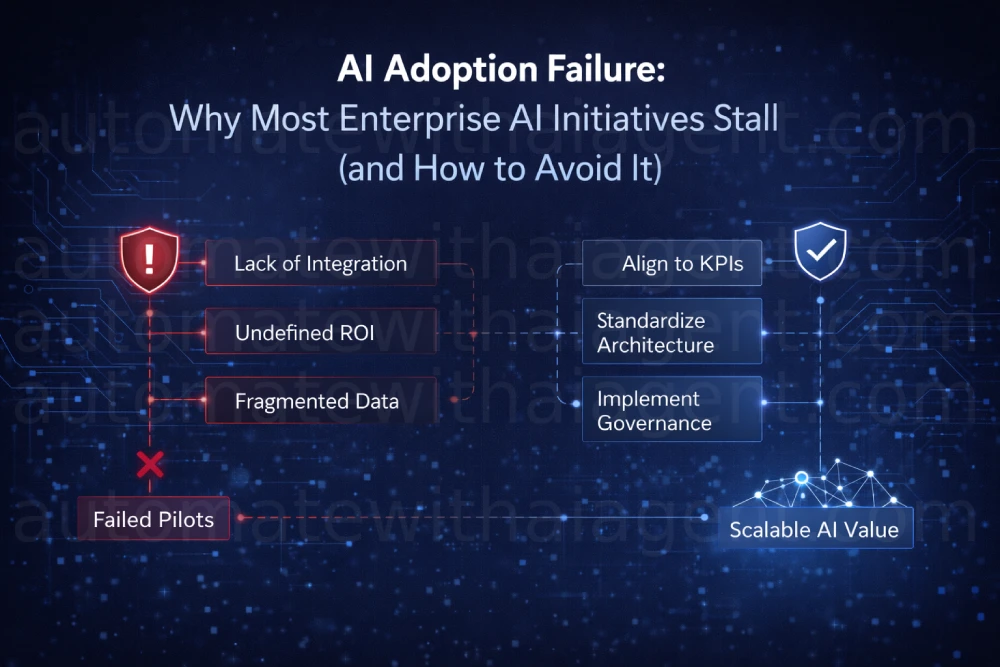
AI Adoption Failure Why Most Enterprise AI Projects Fail (And How to Avoid It)

Enterprise AI initiatives falter not from technological deficits but from the failure to architecturally embed capabilities into value-generating workflows, trapping 95% of pilots in non-production limbo[7]. True scaling demands modular service layers, orchestration engines, and observability platforms aligned to precise business KPIs, transforming experimental tools into autonomous operational assets.
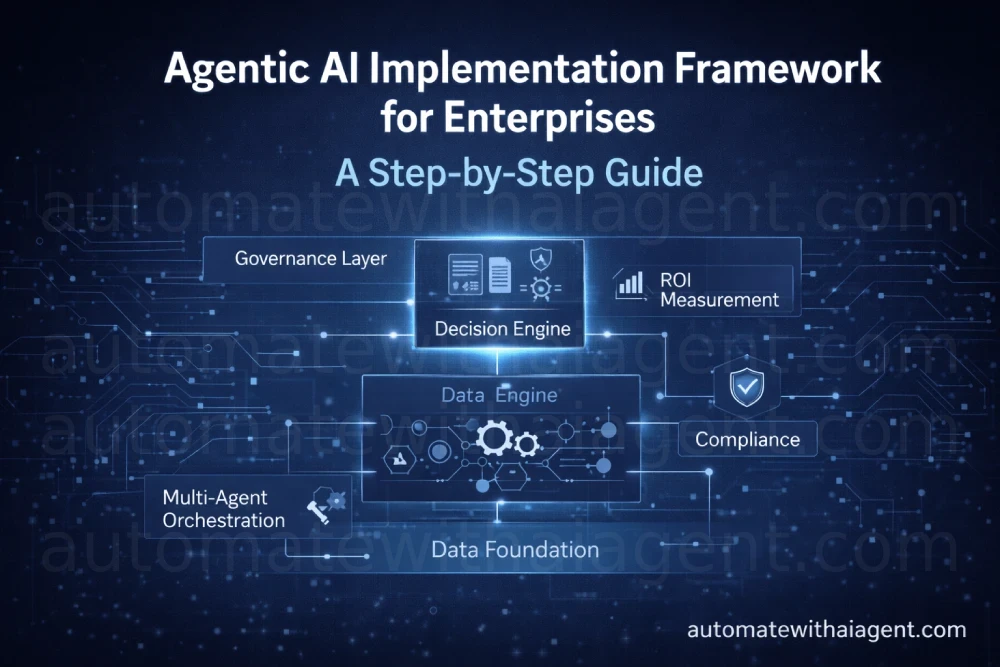

Autonomous Scale: Why Enterprise AI Agent ROI Compounds Exponentially Beyond Pilot Projects

Autonomous Scale: Why Enterprise AI Agent ROI Compounds Exponentially Beyond Pilot Projects

The fundamental tension in enterprise AI agent investment is not whether agents deliver ROI—they do—but whether your organization captures linear returns from isolated automation or exponential returns from scaled, interconnected autonomous workflows. [1] Organizations deploying agents across multiple business functions report 3–6x returns in year one, with mature implementations reaching 10x–12x by year three. [2] The difference between these outcomes is not technology—it is architectural discipline, governance maturity, and the deliberate design of agent ecosystems rather than point solutions. Early adopters who prioritize scaled deployments achieve 43% ROI in customer experience versus 36% for average organizations, a 19% performance premium that compounds annually. [3] This briefing decodes the financial mechanics, technical prerequisites, and organizational decisions that unlock exponential value from agentic AI.

Torq’s $140M Agentic AI SOC Bet: Architecture, Autonomy, and the New Security Value Chain

Torq’s $140 million Series D at a $1.2 billion valuation

Torq’s $140 million Series D at a $1.2 billion valuation is not just another security funding headline; it is a capital-backed assertion that autonomous, agent-based SOCs are moving from experiment to reference architecture. The round, led by Merlin Ventures with participation from existing institutional investors, is explicitly framed around scaling an “AI SOC Platform” built on advanced hyperautomation, AI-led alert triage, and analyst fatigue reduction to deliver full operational autonomy for enterprises and government agencies [1]. For CIOs and Enterprise Architects, the real signal is strategic: agentic AI is being positioned as the primary control plane for security operations, with humans supervising edge cases rather than orchestrating every step. This introduces a new design tension—how far to push operational autonomy in the SOC stack without eroding governance, assurance, and compliance obligations.

Architectural Autonomy in Multi-Agent AI: Balancing Parallel Gains Against Coordination Costs

Multi-agent AI Systems Architecture

Google DeepMind’s empirical analysis across 180 experiments demonstrates multi-agent systems deliver up to 80% performance uplift on parallelizable tasks like financial analysis via centralized coordination, but degrade sequential reasoning by 39-70% due to coordination overhead—pushing enterprises toward task-specific architectural choices for true scalability.[1][3]

Explore with AI
AWAIA Intelligence
Powered by AWAIA™
AI Online

Explore Solutions

What are you exploring today? I can help with MEERA™, LEA™, ISO 42001, AI Governance and Enterprise AI initiatives.