The Linguistic Disconnect in Enterprise Voice AI
Deploying enterprise-grade Voice AI across India reveals a structural blind spot in contemporary speech engineering. Speech-to-text (ASR) and natural language pipelines whose training data and language coverage do not adequately represent the target Indian speech population often operate on assumptions that break down within the Indian communicative landscape. These systems often presuppose monolingual sentence construction, clean grammatical delineation, standardized orthography, and high-fidelity acoustic inputs. In corporate boardrooms and consumer applications throughout the subcontinent, however, everyday communication adheres to entirely different structural dynamics.
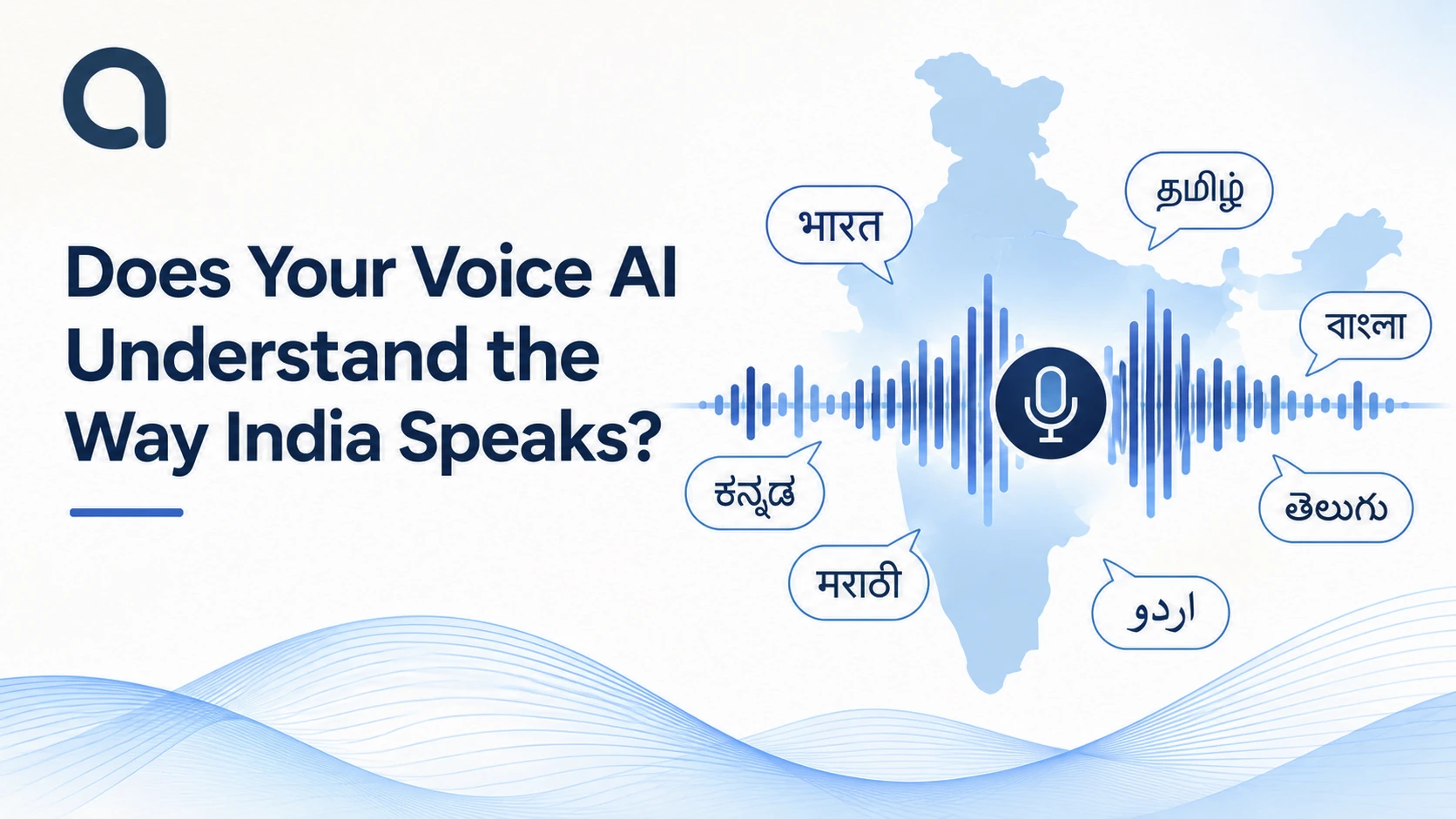
India’s linguistic and acoustic landscape reflects an extraordinary sociolinguistic diversity: 22 constitutionally recognized scheduled languages, numerous regional dialects, complex phonological variations, and continuous intra-sentential code-switching. When an Indian consumer interacts with an automated voice interface, they rarely speak purely in standard textbook Hindi, Tamil, Marathi, or English. Instead, an utterance in Mumbai, Bengaluru, or Lucknow often flows effortlessly across linguistic boundaries within a single sentence: an English noun embedded within a Hindi syntactic frame, inflected with regional Marathi prosody, and delivered over an unstable cellular connection. To standard speech pipelines not built for this pattern, this communicative reality can register as corrupted input, resulting in recognition failures, misattributed intents, and elevated customer abandonment rates.
Bridging this gap generally requires an architectural departure from speech engines whose training data and design assumptions were not built around Indian speech patterns. In AWAIA’s assessment, enterprise leaders should not assume that wrapping global commercial APIs in localized prompt engineering alone resolves Indic conversational challenges. Achieving reliable conversational automation in India typically demands a rigorous engineering evaluation of purpose-built Indic acoustic backbones, phoneme-aware transliteration engines, specialized script-normalization middleware, and semantic-first evaluation frameworks against the real-world conditions under which India speaks.
Deconstructing the Failure Modes of Generic Speech Pipelines
To understand why off-the-shelf voice platforms can struggle in the Indian context, enterprise architects should examine three layers where speech systems built mainly on non-Indian training data and design assumptions are commonly reported to break down in practice: acoustic diversity, intra-sentential code-switching, and orthographic variance. These patterns draw on the general engineering experience of teams building Indic voice systems, not a single controlled study benchmarking every named platform.
1. Acoustic and Dialectal Hyper-Diversity
The phonological structure of Indian languages presents distinct acoustic challenges. Indic languages feature extensive inventories of retroflex consonants, contrasts between aspirated and unaspirated consonants, gemination, and prosodic patterns of stress, duration, and intonation that affect meaning and naturalness. Tonal contrasts are relevant in some Indian languages — Punjabi, for instance — but are not a general feature across the language family and should not be assumed present by default. Acoustic models trained predominantly on datasets dominated by North American or European phonetic inventories can map these retroflex sounds to dental equivalents or omit aspiration cues, generating lexical errors. This is a widely reported engineering observation among practitioners building Indic ASR rather than a benchmarked finding tied to any one named commercial model; where head-to-head results exist — AI4Bharat’s Vistaar suite, for instance — they should be consulted directly for model-specific error rates.
Furthermore, geographic dispersion creates profound dialectal variance. A language such as Hindi or Bengali shifts noticeably in phoneme realization and vocabulary across different districts. Research conducted under Project Vaani — an initiative by the Indian Institute of Science (IISc), ARTPARK, and Google — has underscored that metropolitan studio recordings cannot capture representative Indic speech. The project’s field collection spans roughly 165 districts and, per the published dataset documentation, speech covering around 105 languages and dialects (secondary summaries of the same release cite figures as high as 112, so enterprises should treat the exact count as approximate pending direct review of the dataset card). Project Vaani demonstrates that real-world voice models must reflect the spontaneous, regional pronunciations of rural and peri-urban speakers rather than the curated cadences of urban voice artists. Without this district-level acoustic grounding, enterprise voice systems risk remaining functional mainly for a highly urbanized segment of the population.
2. The Bottleneck of Intra-Sentential Code-Switching
Perhaps the most persistent engineering hurdle in conversational voice interfaces is code-switching and code-mixing. In sociolinguistics, code-switching refers to the alternation between two or more languages within a single discourse. In India, intra-sentential mixing — such as Hinglish (Hindi-English), Tanglish (Tamil-English), or Kanglish (Kannada-English) — is standard conversational practice.
Some multilingual ASR deployments address language mixing with an initial, utterance-level Language Identification (LID) step that classifies an entire incoming audio stream as a single language — “English” or “Hindi,” for instance — before routing it to a dedicated monolingual acoustic and language model. This is a limitation specific to that routing architecture, not a description of all multilingual ASR systems: models built for code-switching, or a single multilingual acoustic model that skips hard LID-based routing, can handle mixed-language input differently. Where utterance-level routing is used, though, it breaks down on an utterance such as: “Mera credit card block ho gaya hai, please new card dispatch kar do.” (My credit card has been blocked, please dispatch a new card).
A preliminary LID module forced to classify this audio into a single bucket either fails or introduces added latency. If routed to an English model, the Indic phonetic structures are mangled; if routed to a standard Hindi model, the English loanwords (“credit card,” “block,” “dispatch”) are either misrecognized or transliterated into garbled native phonemes. Avoiding this specific failure mode requires either a unified multilingual speech architecture capable of continuous, intra-sentential token emission across shared phonetic representations, or a code-switching-aware routing design in place of hard per-utterance LID classification.
3. The Romanized Vernacular and Script Inconsistency
Downstream natural language understanding (NLU) layers and Large Language Models (LLMs) depend on clear textual representations to extract intent. In Indian digital workflows, however, the transcription layer encounters deep orthographic ambiguity. Transcribed Indic speech can be rendered either in its native script (e.g., Devanagari, Gurmukhi, Telugu script) or in informal Romanized text (Latin script).
Informal Romanized Indic has no standardized orthographic convention. The simple colloquial Hindi phrase meaning “give me” can be transcribed arbitrarily by different systems or human users as “mujhe”, “mjhe”, or “muze”. Similarly, long and short vowel distinctions in Latin script create variations such as “kya” versus “kyaa”. If an ASR pipeline transcribes spoken vernacular into non-standardized Latin script, downstream semantic parsing modules often fail to resolve named entities and intents. Conversely, routing the ASR engine to output pure native scripts can increase token counts in some large language models: tokenizer efficiency for a given script depends on that model’s specific tokenizer and training vocabulary, and models whose vocabularies skew heavily toward English are more likely to fragment native-script Indic text into additional tokens, adding inference latency and computational cost. This is not a universal property of every LLM and should be checked against the tokenizer actually in use rather than assumed.
Rethinking Metrics: Why Word Error Rate Distorts Operational Reality
In classical speech engineering, Word Error Rate (WER) and Character Error Rate (CER) — calculated via Levenshtein edit distance against a gold-standard reference transcript — serve as standard benchmarks of system performance. Within the Indic enterprise voice domain, however, relying solely on WER can produce a distorted view of operational efficacy.
Consider two distinct effects, since they differ in both cause and magnitude. First, a script mismatch: if a reference transcript for an utterance meaning “I need to know the loan interest rate” is recorded in Devanagari script (मुझे लोन इंटरेस्ट रेट जानना है), but an ASR model emits the phonetically valid Romanized rendering “Mujhe loan interest rate jaanna hai,” a word-level Levenshtein comparison between the two scripts finds no matching tokens at all, correctly producing a WER of 100%. This is an artifact of comparing across scripts, not evidence that the system failed to understand the utterance; a human reader would recognize both strings as the same sentence. Second, a much smaller effect: minor spelling discrepancies within Romanized vernacular — for instance, reference “Mujhe loan interest rate jaanna hai” versus hypothesis “Mujhe loan interest rate janna hai” (one omitted duplicate vowel) — change only one of six words, giving a WER of roughly 16.7%, not a 100% event. The two effects should not be conflated: a full script mismatch is correctly scored as near-total, while the cumulative impact of many small, meaning-preserving spelling variants across a large transcript volume is a separate measurement problem, even though no single instance is severe.
Research published by organizations such as Sarvam AI argues that deploying Voice AI in India benefits from layered semantic evaluation frameworks used alongside, rather than as an outright replacement for, WER. Enterprise voice pipelines can be evaluated using metrics designed for operational task completion:
- Intent Preservation Score: Measures whether the core customer action (e.g., checking an account balance, disputing a transaction, booking an appointment) is accurately recognized regardless of phonetic or script variations in the transcript.
- Entity Preservation Score: Audits the precise extraction of critical business entities, such as account numbers, dates, personal names, monetary amounts, and product categories, ensuring that phonetic transliteration does not distort underlying transactional data.
- LLM-WER / Semantic Similarity: Leverages an evaluation language model to compare the semantic equivalence of the generated transcription against the ground truth, disregarding benign spelling choices or script alternatives that do not alter communicative meaning.
By moving beyond rigid Levenshtein distance calculations, enterprise engineering teams can more accurately measure whether an Indic speech interface actually fulfills customer requests in high-volume contact center environments. These metric names and definitions are vendor-published (Sarvam AI) rather than independently standardized industry benchmarks, and should be validated against an enterprise’s own data before being treated as comparable across vendors.
Architectural Foundations for Enterprise Indic Voice AI
Constructing a resilient voice engine capable of understanding the nuances of Indian speech requires assembling an end-to-end architecture tailored to local acoustic and linguistic dynamics. Modern enterprise implementations build on several critical technological advancements.
1. Streaming Acoustic Architectures vs. Monolithic Batch Models
Enterprise voice applications, particularly automated telephony and Interactive Voice Response (IVR) systems, operate under tight latency budgets. As an illustrative engineering target commonly used in conversational-AI design — not a figure validated by the Indic research programs cited in this article — many teams aim for an end-to-end turnaround, from the moment the customer stops speaking to the initial acoustic playback of the automated response, of roughly 800 to 1,000 milliseconds. This budget covers Voice Activity Detection (VAD), ASR acoustic decoding, NLU/LLM reasoning, and Text-to-Speech (TTS) generation combined; the achievable figure depends on network conditions, model choice, and use case, and should be benchmarked directly rather than assumed.
While massive, general-purpose speech models such as OpenAI’s Whisper demonstrate broad multilingual capabilities, their standard architectures default to batch-level attention over large audio windows — a documented architectural characteristic of the released models’ standard inference mode, distinct from any claim about their comparative accuracy on Indic languages specifically, which should be assessed via direct benchmarking rather than inferred from architecture alone. Buffering several seconds of speech before initiating decoding introduces latency that can degrade conversational flow. Production-oriented Indic architectures instead rely on streaming Conformer variants (such as 30M-parameter to 430M-parameter FastConformer or RNN-Transducer frameworks) that decode incoming audio frames incrementally. SraVaani 1.0, developed under Project Vaani, illustrates this approach: a 430M-parameter FastConformer model pretrained on speech data spanning roughly 105 languages and dialects across 165 districts, though its released, fine-tuned checkpoint is documented as supporting 63 languages — the broader 65-language figure cited elsewhere appears to describe the wider research program rather than this specific shipped model, and should be confirmed against the live model card before use. Sarvam AI’s Saaras is a separate, commercially offered streaming model built on the same general architectural principle; compact streaming conformers of this kind can deliver both low latency and strong regional coverage, though comparative accuracy for a given deployment should be benchmarked directly rather than assumed from architecture class alone.
2. Telephony-Grade Acoustic Robustness
A significant portion of Indian enterprise customer interactions takes place over Public Switched Telephone Networks (PSTN), cellular connections, or low-bandwidth VoIP channels (such as WhatsApp audio), and signal quality on these channels varies more than a single “8 kHz” figure suggests. Traditional PSTN and many 2G/3G cellular voice paths are narrowband: 8 kHz sampling, compressed with codecs such as AMR-NB, covering a voice band of roughly 300–3400 Hz. Where both endpoints and the carrier support “HD Voice,” calls may instead use AMR-WB, a wideband codec sampling at 16 kHz and extending the usable band to roughly 50–7000 Hz — a materially higher-fidelity signal, not an interchangeable variant of the same 8 kHz channel. These channels also carry high ambient noise from chaotic road traffic, crowded households, or transit hubs, and enterprise telephony integrations should confirm the actual codec and bandwidth per carrier and endpoint rather than assume a uniform narrowband path, since the difference materially affects achievable ASR accuracy.
Acoustic models trained solely on pristine 16 kHz studio recordings can degrade sharply when deployed in these real-world environments. Three related resources are worth distinguishing here, since they are often referenced together but serve different purposes: AI4Bharat’s base Kathbath corpus was recorded under deliberately clean, quiet conditions and is not itself noisy; “Kathbath-Noisy” style variants are separate evaluation sets built by injecting synthetic noise into that clean base, for robustness testing rather than training; and corpora such as Gramvaani consist of naturally noisy, real-world field recordings (rural call-center audio, for instance) rather than synthetically augmented data. Robust enterprise speech engines benefit from incorporating diverse background noise profiles directly into the acoustic training loop — using appropriately licensed, naturally noisy field recordings and/or synthetic noise augmentation as training data, while keeping clean and noised evaluation sets separate for measuring robustness — to help prevent the model from hallucinating or dropping low-energy phonetic segments when operating across noisy mobile connections.
3. Language Identification and Script Unification Middleware
To navigate code-switching without introducing massive computational overhead, modern Indic pipelines deploy dedicated classification middleware. IndicLID, developed by the research consortium at AI4Bharat (IIT Madras), is a text-based classifier: it operates on the decoded transcript tokens produced by the upstream ASR system, not on raw audio frames. It spans 47 classes: 24 native scripts, 21 romanized scripts, English, and a residual “Others” category for non-linguistic or unclassifiable text.
By placing an efficient text classifier like IndicLID directly downstream of the streaming acoustic model’s decoding stage — that is, on its text output — systems can identify the script and language register of incoming tokens and route them appropriately. Three distinct techniques are often used together here and should not be treated as interchangeable. Script normalization standardizes inconsistent renderings within one script — collapsing “mujhe,” “mjhe,” and “muze” to a canonical spelling, for example. Transliteration converts text between scripts, such as Devanagari to Latin, a different operation from translating between languages (a task handled by tools such as IndicTrans2). Cross-lingual lexical or semantic representations — shared embedding spaces that let a model trained on a high-resource language transfer some capability to a related low-resource language — are a modeling technique used in some research systems, not a routine, out-of-the-box capability present in every Indic pipeline. Which combination an enterprise needs depends on the deployment: a pipeline that must output clean native-script text needs script normalization; one that must support cross-script search or downstream English-only NLU needs transliteration; a team training a model for a very low-resource dialect may additionally look at cross-lingual representation transfer.
4. Joint Speaker Diarization and Attribution
Real-world customer support calls in India are characterized by rapid conversational overlap, interruptions, and fast turn-taking. When an ASR system decouples speaker diarization (determining who spoke when) from speech recognition, the resulting transcripts frequently confuse agent statements with customer statements. Sarvam AI’s research with Indic DiarBench — a joint diarization-ASR benchmark built with AI4Bharat, covering all 22 scheduled languages across roughly 108 hours of multi-speaker conversation from 485 speakers in 189 districts — finds that independent diarization modules can generate substantial attribution errors. Joint speaker-attributed ASR, where acoustic features and speaker identities are decoded synchronously within a unified multi-task network, is an architectural approach enterprises can evaluate as an alternative to decoupled diarization-plus-ASR pipelines, particularly where benchmarking of this kind shows the decoupled approach producing high attribution error. This does not reflect evidence of broad production adoption of joint architectures specifically, and no industry-wide shift toward them is claimed here.
The Public Digital Infrastructure Advantage
Enterprises entering the Indian conversational AI market can draw on one of the world’s most active public digital infrastructure ecosystems for language technology. Spearheaded by the Ministry of Electronics and Information Technology (MeitY), the Digital India Bhashini Division has established open foundational registries intended to broaden access to linguistic AI across all 22 scheduled languages.
Through collaborative initiatives uniting academic institutions like IIT Madras (AI4Bharat) and IISc Bangalore, this ecosystem has produced open resources with varying institutional origins, and the distinction matters for attribution. IndicWhisper and IndicConformer were developed directly by AI4Bharat and are distributed through the Bhashini/AIKosh repositories. BhashaDaan is a citizen crowdsourcing platform operated directly under the Bhashini mission (MeitY) to collect open-license language data. Kathbath and Shrutilipi, by contrast, were built by AI4Bharat — Shrutilipi mined from All India Radio’s public news-bulletin archives, Kathbath from crowdsourced read-speech recordings — with funding that includes Bhashini/MeitY and Nilekani Philanthropies; they are hosted and distributed through the broader Bhashini/AIKosh ecosystem rather than being Bhashini-authored datasets. Enterprises should confirm current licensing terms on each dataset’s own page rather than assume a single uniform Bhashini license applies across all of them.
A separate, more recent model — Indic-Transcribe, a 1.2-billion-parameter speech-to-text model built on an architecture derived from NVIDIA’s Canary family — illustrates a different category: it was developed by BodhanAI in collaboration with AI4Bharat researchers at IIT Madras, and is a commercially released model, not a MeitY/Bhashini public-sector artifact. Its reported language coverage varies across sources (roughly 22 scheduled languages plus English and several additional dialects, depending on the variant), and no authoritative source currently confirms a training-hours figure for it, so none is cited here. The distinction matters for due diligence: public-sector Bhashini releases and venture-backed commercial models carry different licensing, support, and governance assurances, even where both are described as “open” or “open-weight.”
Organizations can evaluate, fine-tune, and self-host open-weight models of either category on localized infrastructure as one option among several — weighed against commercially hosted Indic-focused APIs and global general-purpose providers on the dimensions that matter for the deployment at hand, rather than assumed preferable by default.
Security, Governance, and Data Sovereignty
Deploying conversational Voice AI at enterprise scale introduces significant governance and regulatory responsibilities. Voice inputs can carry voice characteristics and other identifiable personal information, ambient household details, and sensitive personal narratives that require rigorous safeguarding, separate from any specific statutory classification.
Data Protection Compliance: Commencement Status and Scope
India’s Digital Personal Data Protection (DPDP) Act, 2023 and DPDP Rules, 2025 commence in stages under two separate Gazette notifications, both dated 13 November 2025: G.S.R. 843(E), bringing provisions of the DPDP Act into force in stages, and G.S.R. 846(E), bringing the DPDP Rules into force on a parallel but distinct staged schedule. A subsequent corrigendum, G.S.R. 892(E), dated 11 December 2025, corrects textual wording in Rule 1(3) and Rule 1(4) of the DPDP Rules notification; it does not alter any of the commencement dates described below. The Act’s and Rules’ schedules should not be treated as a single commencement date.
Under the staged structure established by G.S.R. 843(E) and G.S.R. 846(E), an initial set of provisions — covering the Data Protection Board of India and its procedural rules — took effect on the notification date itself, 13 November 2025. A one-year tranche, effective 13 November 2026, brings into force two specific Act provisions under G.S.R. 843(E): Section 6(9), concerning registration of Consent Managers with the Data Protection Board, and Section 27(1)(d), the Board’s power to inquire into breaches of Consent Manager registration conditions and impose penalties — alongside Rule 4 of the DPDP Rules (registration and obligations of Consent Managers), commenced separately under G.S.R. 846(E)’s own one-year tranche. The Act’s and Rules’ one-year tranches are two distinct instruments commencing related but separately specified provisions, not a single consolidated clause. The remaining eighteen-month tranche, effective 13 May 2027 and therefore not yet in force as of this article’s publication, brings into force the Act’s Sections 3–5, Sections 6(1)–(8) and 6(10), Sections 7–17, Section 27 (except clause (d) of Section 27(1)), Sections 28–34, Sections 36 and 37, and Section 44(2) under G.S.R. 843(E) — covering notice and verifiable-consent requirements, security safeguards, breach-reporting duties, the Section 16 cross-border transfer provisions, the remaining Consent Manager provisions in Section 6 not already commenced in the one-year tranche, and the Board’s remaining powers and procedures under Sections 27–34, the Central Government’s powers under Sections 36 and 37, and the consequential amendments to the Information Technology Act, 2000 under Section 44(2) — together with Rules 3, 5–16, 22 and 23 under G.S.R. 846(E). As with the one-year tranche, the Act’s and Rules’ eighteen-month commencements are set out separately in their respective notifications. Enterprises should confirm the current status of each specific obligation against G.S.R. 843(E) and G.S.R. 846(E), as corrected by G.S.R. 892(E), directly before setting compliance deadlines.
Two further points describe the content of the Act itself. First, the DPDP Act does not create a separate “sensitive personal data” or biometric-data category carrying heightened obligations, unlike the GDPR or India’s earlier 2011 SPDI Rules, which do classify biometric data as sensitive and remain the operative framework for that classification until fully superseded. Enterprises should not assume the DPDP Act imposes GDPR-style special-category handling specifically for voice or biometric data. Second, Section 16 of the Act — once in force from 13 May 2027 — establishes a cross-border transfer model closer to a negative list than a localisation mandate: personal data may be transferred outside India by default, except to countries the Central Government specifically restricts by notification. This differs materially from a blanket data-residency requirement, and enterprises should not describe general DPDP compliance, once Section 16 commences, as requiring that all voice data remain within India.
Separately, under domain-specific oversight from the Reserve Bank of India (RBI), a 2018 directive on “Storage of Payment System Data” requires payment system providers regulated under the Payment and Settlement Systems Act, 2007 to store the full data relating to a payment transaction exclusively in India, even where processing occurs abroad. This requirement is scoped specifically to payment-system data — transaction and settlement records, customer payment data, payment credentials — and does not extend to general customer-service voice recordings outside the payment flow. Enterprises operating voice agents that touch payment transactions, such as voice-initiated banking or bill-payment flows, should scope their RBI compliance obligations narrowly to the payment-data elements of that interaction, and should not treat the RBI directive as a general voice-recording localisation rule. Processing enterprise voice streams through overseas commercial cloud endpoints carries compliance considerations that will sharpen once DPDP’s substantive provisions and any applicable sector-specific rules commence, and hosting Indic speech pipelines on domestic infrastructure remains, in AWAIA’s judgement, a reasonable risk-reduction and latency-optimization choice for many enterprises — but it should be presented as a prudent architectural decision made ahead of Section 16’s 13 May 2027 commencement, not as a strict mandate under current law.
Acoustic Privacy and Anonymization
Enterprise data pipelines should implement encryption in transit and at rest for voice streams. This is distinct from genuine end-to-end encryption: because ASR, diarization, and NLU processing require the voice pipeline’s own servers to decrypt and operate on the audio and transcript, true end-to-end encryption — where only the original conversing parties hold the decryption keys — is generally not compatible with server-side speech processing, unless specific techniques such as confidential-computing enclaves are deliberately architected in. Enterprises should describe their security posture accurately as encryption in transit and at rest with controlled, auditable server-side access, rather than as “end-to-end encryption,” unless they have specifically built for the latter.
Additionally, real-time audio streams should pass through automated redaction layers to strip personally identifiable information (PII) — such as Aadhaar numbers, Permanent Account Numbers (PAN), and debit card details — from the transcript before storing audio archives or feeding transcripts to downstream model retraining pipelines. Transcript-level redaction only cleans the text, however: the underlying audio recording may continue to contain identifiable personal information and, where voice characteristics are processed for identifying an individual, may also involve biometric information. Transcript-level redaction does not remove this information from the original audio. Where raw audio is archived rather than discarded after processing, enterprises should treat audio redaction (muting or masking the specific spoken segments), segmentation, or a deliberately short, access-controlled retention window as a separate decision from transcript redaction, not something transcript-level PII stripping already accomplishes.
Mitigating Dialectal Bias and Hallucination
An ethical imperative in voice deployment is ensuring that automated agents do not systematically disenfranchise speakers of non-standard dialects or under-resourced languages. Field audits frequently reveal that speech recognition models exhibit higher error rates when processing speech from rural districts or non-metropolitan demographics. Continuous bias auditing across diverse socioeconomic cohorts is essential. Furthermore, when Text-to-Speech (TTS) models (such as Bulbul or Indic-TTS) generate responses in code-mixed languages, they should be audited for incorrect or unnatural prosody, pronunciation, and intonation — including abrupt pitch resets at language-switch boundaries — which can disrupt user comprehension and diminish trust.
An Indicative 12-Month Enterprise Implementation Roadmap
Transitioning from a speech pipeline poorly matched to Indian conditions to a resilient Indic Voice AI architecture requires a methodical, risk-managed progression. The following phased roadmap is an indicative planning framework, not a guaranteed implementation timeline — actual duration varies substantially by enterprise size, existing telephony infrastructure, regulatory review cycles, and in-house ML engineering maturity. It outlines one reasonable structure for an enterprise deployment across four operational quarters, to be adapted rather than followed as a committed schedule.
Phase 1: Research, Acoustic Auditing, and Toolchain Setup (indicative Months 1–3)
- Audit existing voice interactions to quantify the incidence of code-switching, dialectal variations, and telephony noise across primary customer contact channels, including which carriers/endpoints use narrowband versus wideband codecs.
- Establish formal benchmarks against the AI4Bharat Vistaar test suite (59 benchmarks across 12 languages) and Bhashini reference datasets to baseline current model performance.
- Prototype phoneme-aware transliteration and script-normalization middleware using open-source libraries.
- Define and implement semantic evaluation metrics — specifically Intent Preservation Score and Entity Preservation Score — alongside traditional WER baselines, validating any vendor-published metric methodology against your own data before adopting it.
Phase 2: Model Adaptation and Robustness Engineering (indicative Months 4–6)
- Select and evaluate streaming acoustic baselines (e.g., SraVaani FastConformer or IndicConformer) within a local, containerized evaluation environment, confirming current language coverage and licensing against each model’s published card.
- Fine-tune acoustic backbones using representative training data, including synthetic noise augmentation and appropriately licensed, naturally noisy field recordings (e.g., Gramvaani-style corpora) for resilience against lossy narrowband and wideband telephony codecs. Keep validation and held-out test datasets — including any Kathbath-Noisy-style synthetic evaluation sets — separate from training data to avoid data leakage and preserve the credibility of robustness measurements.
- Integrate high-speed, text-based classification tools like IndicLID downstream of the ASR decoder to identify incoming native versus Romanized vernacular tokens dynamically.
- Evaluate downstream language model adapters for resolving code-switched inputs without triggering tokenization bloat.
Phase 3: Controlled Pilot and Telephony Integration (indicative Months 7–9)
- Deploy streaming voice agents across select regional contact centers, testing real-time performance across PSTN, cellular, and low-bandwidth VoIP lines, across both narrowband and (where available) wideband codec paths.
- Benchmark end-to-end turnaround latency against an illustrative 800–1,000 millisecond target for audio-to-audio interaction loops, refining the figure for the specific pipeline and use case rather than treating it as a fixed requirement.
- Implement joint speaker-attributed ASR in live customer service workflows to assess speaker misattribution risk.
- Validate data-handling practices against the specific provisions and tranche dates in G.S.R. 843(E) and G.S.R. 846(E) (13 November 2025), and any applicable sector-specific rules (e.g., RBI payment-data localisation, where relevant) — rather than assuming blanket DPDP compliance can be established before the relevant obligations actually commence.
Phase 4: Full-Scale Deployment and Continuous Learning (indicative Months 10–12 and beyond)
- Scale the voice interface across enterprise operations as pilot results warrant, including automated customer support, transactional voice banking, and omni-channel telephony.
- Deploy continuous monitoring pipelines tracking LLM-WER, Intent Preservation, and regional user abandonment rates.
- Implement an ethical governance framework featuring automated bias audits and feedback loops to identify underrepresented regional dialects requiring targeted supervised fine-tuning.
Conclusion: The Strategic Advantage of Localized Speech Intelligence
Deploying voice systems that genuinely understand the linguistic fabric of India is not an incremental optimization; it is a meaningful enterprise capability for most organizations serving this market. As digital access extends beyond tier-one metropolitan centers into semi-urban and rural areas, voice is becoming a primary interface through which hundreds of millions of citizens interact with digital commerce, banking, and public services.
Enterprises that rely on generic global speech architectures without evaluating them against Indian acoustic and linguistic conditions risk higher customer friction, inaccurate transcriptions, and slower adoption. Organizations that rigorously compare regional acoustic architectures, code-switched handling, streaming model options — open-weight and commercial alike — and semantically-aware evaluation methods against their specific use case are better positioned to build durable, scalable voice experiences in the Indian market. Understanding the way India speaks is ultimately about recognizing that linguistic diversity is not an operational barrier to be simplified, but an architectural reality to be mastered on the evidence, rather than assumed.
Sources & References
The technical architectures, datasets, and performance benchmarks referenced throughout this strategic analysis are grounded in the following foundational research repositories and initiatives. Figures drawn from vendor blogs are vendor-reported claims, not independently audited benchmarks, and are marked as such above where relevant. Where a legal or regulatory claim could not be verified against a primary government source, that limitation is stated in the text rather than resolved by citing secondary commentary as if it were primary.
- AI4Bharat Research Consortium (IIT Madras): Official Portal (https://ai4bharat.iitm.ac.in/); IndicWhisper Publication and Vistaar Benchmark Details (https://ai4bharat.iitm.ac.in/indic-whisper); Open Source Indic Models Repository (https://models.ai4bharat.org/); IndicLID / Bhasha-Abhijnaanam paper (arXiv:2305.15814); Vistaar benchmark paper (arXiv:2305.15386).
- Project Vaani (Indian Institute of Science & ARTPARK, supported by Google): Project Overview and Corpus Details (https://vaani.iisc.ac.in/); Open Source Models and SraVaani FastConformer (https://vaani.iisc.ac.in/models), including current released-checkpoint language coverage (https://huggingface.co/ARTPARK-IISc/SraVaani-1.0); Hugging Face Dataset Repository (https://huggingface.co/datasets/ARTPARK-IISc/Vaani); Academic Paper: VAANI: Capturing the language landscape for an inclusive digital India (arXiv:2603.28714).
- Digital India Bhashini Division (Ministry of Electronics and Information Technology – MeitY): National Language Mission (https://bhashini.gov.in/); AIKosh National Open AI Model and Dataset Repository (https://aikosh.indiaai.gov.in/).
- Sarvam AI Research: Evaluating Indian Language ASR / semantic metrics (https://www.sarvam.ai/blogs/evaluating-indian-language-asr); Introducing Saaras V3 (https://www.sarvam.ai/blogs/asr); Indic DiarBench: Joint Diarization-ASR Benchmark (https://www.sarvam.ai/blogs/indic-diarbench).
- Indic-Transcribe (BodhanAI, with AI4Bharat/IIT Madras collaboration): Model cards (https://huggingface.co/bodhan-ai/indic-transcribe-core); a commercial model, not a MeitY/Bhashini release — verify current specifications with the vendor directly before citing figures.
- DPDP Act 2023 and DPDP Rules 2025: commencement notifications G.S.R. 843(E) (https://www.meity.gov.in/static/uploads/2025/11/c56ceae6c383460ca69577428d36828b.pdf) and G.S.R. 846(E) (https://www.meity.gov.in/static/uploads/2025/11/53450e6e5dc0bfa85ebd78686cadad39.pdf), both dated 13 November 2025 (Gazette of India), plus corrigendum G.S.R. 892(E), dated 11 December 2025 (https://www.meity.gov.in/static/uploads/2025/12/3c7ebbae0e5456f493f486e6845df86b.pdf), which corrects wording in Rule 1(3) and Rule 1(4) without changing commencement dates. Confirm the current text of all three notifications directly before relying on a specific date for a compliance deadline.
- RBI “Storage of Payment System Data” (2018): official RBI citizen’s-corner page (https://website.rbi.org.in/web/rbi/-/citizens-corner/storage-of-payment-system-data-2995) and RBI FAQ (https://rbi.org.in/Scripts/FAQView.aspx?Id=130), circular DPSS.CO.OD.No.2785/06.08.005/2017-18, scoped to PSS Act–regulated payment system providers.
– SraVaani 1.0 model architecture: 430M-parameter FastConformer (verified, per current model card), pretrained on Project Vaani speech data spanning approximately 105 languages/dialects across roughly 165 Indian districts; the released, fine-tuned checkpoint supports 63 languages (the “65 languages” figure found elsewhere describes the broader research program, not this specific shipped model).
– Indic-Transcribe model capacity (vendor-reported, BodhanAI with AI4Bharat/IIT Madras collaboration): 1.2 billion parameters, Canary-derived architecture; reported language coverage varies 22–27 across sources depending on variant; no verified training-hours figure exists and none is cited.
– Vistaar benchmark (verified): 59 evaluation benchmarks across 12 Indian languages, compiled by AI4Bharat.
– IndicLID coverage (verified): 47 language identification classes spanning 24 native scripts, 21 romanized scripts, English, and a residual “Others” category; operates on decoded ASR text output, not raw audio.
– Telephony channel characteristics (verified general telecom specification): narrowband PSTN/cellular voice typically samples at 8 kHz using codecs such as AMR-NB (~300–3400 Hz band); wideband “HD Voice” calls using AMR-WB sample at 16 kHz (~50–7000 Hz band) — materially different signal paths, not variants of the same bandwidth.
– Telephony and latency engineering target (illustrative engineering target, not a validated Indic research benchmark): turnaround budget of roughly 800 to 1,000 milliseconds for enterprise telephony, requiring streaming acoustic decoding rather than batch inference to stay within that range; the achievable figure depends on the full pipeline and should be benchmarked per deployment.
About AWAIA
AWAIA is an enterprise AI advisory firm focused on enterprise AI architecture, agentic AI systems, multi-agent workflow design and intelligent automation.
Our Strategic Implementation & AI Architecture Division specializes in:
- Enterprise AI agent architecture design
- Multi-agent orchestration frameworks
- ROI measurement and financial modelling
- Governance-first deployment strategies
- Agent performance optimization
For advisory engagements or enterprise consulting inquiries: