
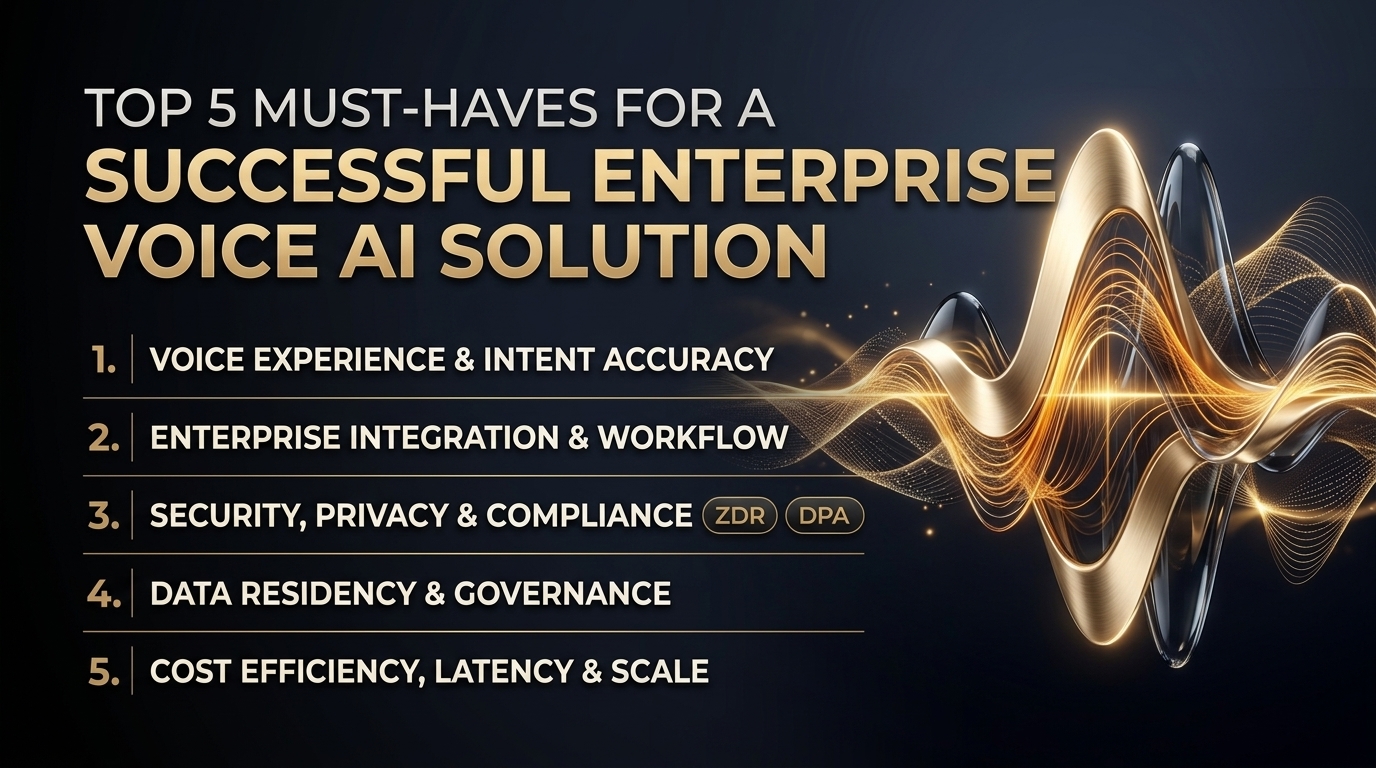
Most enterprise voice AI pilots don’t fail because the underlying language model is weak. They fail because the surrounding system — real-time audio, interruptions, multi-agent handoffs, security boundaries, data governance, and operating cost — was never engineered as carefully as the model prompt was. Teams that chain a transcription API, an LLM call, and a text-to-speech API over plain HTTP get something that answers correctly in a demo and falls apart under a live caller who talks over the agent, changes their mind, or needs routing from billing to fraud. Turning a voice agent into a dependable operational asset means treating it as a systems engineering problem first, and a prompting problem second.
This piece sets out five areas enterprise architects and technology leaders need to get right, with particular attention to where marketing language in this space blurs distinctions that actually matter: what’s encrypted and what isn’t, what’s durable and what’s transient, where data actually lives and for how long, and what a deployment really costs to run.
1. Streaming-First Infrastructure and Real-Time Architecture
A voice call has two logically separate layers. Signaling — call setup, teardown, and routing — is handled by the Session Initiation Protocol (SIP). The actual audio, once a call is established, travels separately over the Real-time Transport Protocol (RTP), built for time-sensitive media delivery rather than guaranteed in-order arrival. Conflating these two layers is a common source of confusion in architecture write-ups, and it matters because they are secured differently, as covered in the security section below.
Legacy IVR and many early LLM-based voice systems share the same failure mode: audio is recorded in full, sent as a complete file to a transcription service, passed through a language model, and only then converted back to speech. Each step is a discrete round trip, and the delays compound. A streaming-first architecture instead keeps audio moving continuously: a WebRTC or SIP-based media server ingests audio at the edge and forwards it as a live stream to an ASR engine that emits partial transcriptions while the caller is still speaking.
On the generation side, the inference engine should begin emitting tokens before it has finished composing a full response, and those tokens should be handed to a text-to-speech engine incrementally, so synthesized audio for the first part of a sentence can start playing while the model is still generating the rest. This requires an orchestration layer — typically an async event loop — moving data forward in small chunks rather than waiting for complete units at each stage. None of this requires naming specific vendors; the pattern is what matters, and multiple commercial and open-source components exist in each category.
2. Voice Quality, Interruption Handling and Conversational Experience
The clearest signal that a voice system was built as a chained API call rather than a real-time system is what happens when a caller interrupts it. A system without proper interruption handling keeps talking until its audio buffer empties regardless of what the caller just said — a “barge-in” failure that reliably frustrates callers and can cause transactional errors when the caller’s correction is simply never heard.
Fixing this means moving interruption handling out of the language model and into a dedicated, low-level control path. A voice activity detection (VAD) component runs continuously on the incoming audio, independent of the language model, and raises an interrupt signal the moment it detects the caller speaking over the agent’s output. Three things then need to happen within a short, bounded window: the outgoing audio buffer must be flushed so playback stops immediately; any in-flight language model generation for the interrupted turn should be cancelled, both to save compute and to avoid a race between the cancelled response and the new input; and the conversation state needs updating to reflect that the agent was cut off, so the next turn responds to what the caller actually said.
It’s worth being precise about what “fast” means here rather than citing a single universal number. Human turn-taking tolerance varies by language, context, and individual expectation, and there isn’t a single empirically settled threshold that applies uniformly across enterprise voice deployments; claims to the contrary should be treated skeptically. What’s measurable and useful is the system’s own interrupt-to-silence latency — the time between VAD detecting speech and the agent’s audio actually stopping — which should be tracked as an internal engineering metric rather than asserted as a universal human-perception constant.
3. Agent Orchestration, Workflow Control and Context Continuity
Enterprise voice interactions rarely stay inside one domain. A caller might start by checking an account balance and end up disputing a charge or being transferred to a specialist. Rather than cramming every task into one large system prompt — which increases hallucination risk and cost as the prompt grows — a more scalable pattern splits work across specialized agents that hand off a bounded, well-defined context when a conversation moves between domains.
The hard part is not routing; it’s making sure context survives the handoff. Two distinct technologies get conflated here in a lot of architecture writing. Protocol Buffers (Protobuf) is a binary serialization format: a message’s structure is defined in a `.proto` file, and generated code encodes and decodes it across services. JSON Schema, separately, validates the structure of a JSON document against a set of rules. One is about efficient serialization, the other about validating document shape — using one does not automatically validate or enforce the other. A system needing both typically defines the Protobuf message for the wire format and, where a JSON representation is also exchanged for logging or audit trails, validates that separately against a JSON Schema.
The other common mistake is choosing a transport for state handoff based on how fast it sounds rather than what guarantee it provides. Redis Pub/Sub delivers to currently-connected subscribers with at-most-once semantics: if no subscriber is listening, or one disconnects, that message is gone, with no replay — reasonable for ephemeral notifications but the wrong tool for conversational state a downstream agent cannot afford to lose. For state that must survive a dropped connection, Redis Streams — an ordered, appendable log with consumer groups tracking delivery per-consumer — is the appropriate mechanism, or the authoritative record should live in a durable data store the handoff references rather than carries.
4. Security, Data Governance and AI Infrastructure Compliance
Voice systems are frequently described as being “secured with TLS,” which is true but incomplete. TLS 1.3 secures signaling and application-layer connections — SIP session setup, control-plane APIs, dashboards — not the RTP media stream itself. Media confidentiality on the wire is the job of SRTP, with WebRTC session keys typically established through a DTLS handshake over the media path (DTLS-SRTP). Internal service authentication is separate again: encryption says nothing about whether the service on the other end is who it claims to be, which identity mechanisms like OAuth 2.0 or signed JWTs handle, layered on top of transport encryption rather than substituting for it. Network microsegmentation adds a third layer, limiting what a compromised component can reach even if its credentials or encryption are defeated.
Privacy requires similar precision. Not every recording is automatically “biometric data” in the regulatory sense: a voice recording is personal data, a transcript derived from it is personal data, and a voiceprint specifically processed to uniquely identify a person is what triggers GDPR’s special-category treatment (Article 9) — ordinary recordings used only for transcription don’t fall into that category unless the system also does speaker identification. GDPR applies based on the data subject’s or controller’s location, not universally; CCPA/CPRA applies to covered businesses handling California residents’ data above defined thresholds. Cross-jurisdiction deployments need a legal assessment of which regime applies, separate from the engineering controls — consent, purpose limitation, retention limits, access control, deletion, and audit logging — that implement whatever that assessment requires.
None of that answers a more consequential question for regulated enterprises: where does an AI provider actually process this data, how long does it keep it, and under what contract. A cryptographically sound pipeline can still create regulatory exposure if the model provider trains on prompts or nobody can state which region an inference call ran in — the layer most architecture discussions skip, and where BFSI (banking, financial services and insurance) deployments run into trouble first.
Data residency and data sovereignty are related but distinct: residency is simply where data is stored or processed; sovereignty is which jurisdiction’s laws apply to it, based on location, the processing entities, and whose data it is — a transcript stored in-region can still be subject to a foreign government’s legal access powers if the processing entity is incorporated elsewhere. Neither has one answer for a voice pipeline, because the data isn’t one thing: audio, STT transcripts, LLM prompts/outputs, session memory, extracted PII, telemetry logs and backups can each land in a different place even inside one “regional” deployment. A regional cloud endpoint constrains where primary compute runs; it doesn’t automatically constrain where logs aggregate, where a support engineer sits, or where backups replicate. Ask providers, category by category, where each is stored and processed, and whether that changes for logging, backup or support access.
Zero Data Retention (ZDR) is a specific, provider-defined commitment, not a guarantee that nothing is stored anywhere in the stack. Where offered, it typically means prompts and outputs aren’t persisted after the response is returned, subject to exceptions — abuse-monitoring retention commonly survives ZDR, and some models or features are excluded from eligibility even on an approved account. ZDR is usually scoped to specific APIs or endpoints, not a provider’s whole product surface, and enabling it commonly requires approval rather than a default toggle. Critically, ZDR at the model provider says nothing about the telephony leg, the STT/TTS vendor, the orchestration layer’s own logs, or the enterprise’s application database — each may retain the same conversation on its own schedule. Confirm ZDR scope in writing, per endpoint.
A Data Processing Agreement (DPA) is the contractual counterpart to these controls, not a substitute for them. Where GDPR applies, Article 28 requires a contract of this kind between controller and processor, and Article 32 requires both to implement risk-appropriate security measures — a DPA is how a controller documents meeting that requirement, not a document that satisfies it by existing. A signed DPA does not itself establish compliance; it records what the vendor has agreed to, which the enterprise must still verify operationally: controller/processor roles per data category, permitted purposes, subprocessor disclosure, processing locations and transfers, breach notification, retention and deletion terms, and audit rights that let the enterprise check the other commitments rather than just assert them.
Regional inference and regional processing get used loosely. Regional storage, regional model inference, regional processing by supporting AI services (embeddings, moderation), regional logging, and regional handling by subprocessors or support staff are five separate commitments — meeting one doesn’t imply meeting the others. A provider storing data in-region by default may still route inference to a global compute pool unless a regional or data-zone deployment type is explicitly selected; one offering regional inference may still ship operational logs to a global observability platform. Get the specific commitment in writing for the exact model, endpoint and deployment configuration in use, not the provider’s product line in general.
End-to-end data flow ties this together. A voice AI call moves through a chain — caller → telephony provider → speech recognition → orchestration → LLM inference (and any embedding/retrieval calls it triggers) → tool/API integrations → text-to-speech → caller — and each hop is a separate vendor relationship with its own storage, logging and subprocessor footprint, assessed on its own rather than assumed to inherit the posture of its neighbors. Where a hop crosses a border covered by GDPR, Chapter V (Articles 44–49) sets the conditions under which that transfer is lawful — an adequacy decision, standard contractual clauses, or another recognized safeguard — identified per hop, not assumed once for the whole pipeline. A data-flow inventory paired with a subprocessor register is how this gets tracked in practice.
The following is an enterprise architecture and vendor-assessment checklist, not a universal regulatory compliance list — the applicable legal requirements still depend on jurisdiction and should be confirmed separately.
| Control area | What the enterprise must verify |
|---|---|
| Data residency | Storage and processing locations for every data category (audio, transcripts, prompts/outputs, session memory, PII, logs) |
| Regional inference | Actual inference region for the specific model and endpoint selected, not the provider’s general claim |
| ZDR | Retention scope, documented exceptions, and which APIs/endpoints/services it actually covers |
| DPA | Controller/processor roles, security obligations, breach notification, deletion terms, audit rights |
| Subprocessors | Full list of downstream providers, their locations, and what access each one has |
| Logging | What is logged, how long it’s kept, and where log processing/aggregation occurs |
| Backups | Replication targets, disaster-recovery locations, and deletion propagation to backups |
| Data transfers | Cross-border flows in the pipeline and the legal transfer mechanism relied on for each one |
5. Operational Reliability, Performance Measurement and Economics
“Latency” in a voice system is not one number. A useful measurement framework breaks the pipeline into stages — audio ingress, voice activity detection, ASR transcription (partial versus final), language model time-to-first-token and full generation, any orchestration or tool-call steps, TTS synthesis, and time to first audible sample. Time-to-first-token measures only the language model’s contribution, not end-to-end latency; a system can have excellent TTFT and still feel slow if ASR finalization, tool calls, or TTS are the actual bottleneck. Measure under realistic concurrency — the load profile production will actually see — since inference queuing and shared infrastructure behave differently under load.
The economics deserve equally specific treatment, without inventing numbers that weren’t measured. Cost per completed interaction has components that should be tracked separately: per-minute or per-character charges for streaming ASR and TTS; token consumption, which tends to grow over a call because many architectures resend accumulated history each turn, so longer calls get disproportionately more expensive; SIP trunking charges; compute for infrastructure running concurrently with active calls; and failed interactions — retry loops or human escalations, which should count as a cost of the automated system rather than the human team’s baseline overhead.
None of this is meaningful in isolation. What matters to an enterprise deciding whether to expand a pilot is the comparison against the existing operating model: average handle time, cost per contact, and abandonment or escalation rate for the current IVR or live-agent process, on the same basis as the new system’s equivalents. Track availability and incident rate once live, too — an outage in a voice channel has a different blast radius than a chat widget going down. Building this measurement discipline before a wider rollout is what turns “the pilot felt fast” into an actual business case, or reveals that it isn’t one yet.
Where This Leaves the Deployment Decision
None of the five areas above is optional, and none is primarily about model quality. Streaming infrastructure determines whether a conversation feels natural at all; interruption handling determines whether it feels respectful; orchestration determines whether context survives a handoff; security, privacy and data governance determine whether the system is actually compliant rather than just plausible-looking; and cost measurement determines whether anyone can defend the deployment past the pilot stage. Enterprises that treat these as engineering requirements, each with its own correctness criteria, are the ones that get voice AI past the prototype and into something the business actually relies on.
Sources & References
- IETF RFC 3261 — SIP: Session Initiation Protocol: https://datatracker.ietf.org/doc/html/rfc3261
- IETF RFC 3550 — RTP: A Transport Protocol for Real-Time Applications: https://datatracker.ietf.org/doc/html/rfc3550
- IETF RFC 3711 — The Secure Real-time Transport Protocol (SRTP): https://datatracker.ietf.org/doc/html/rfc3711
- IETF RFC 5764 — DTLS Extension to Establish Keys for SRTP (DTLS-SRTP): https://datatracker.ietf.org/doc/html/rfc5764
- IETF RFC 8446 — The Transport Layer Security (TLS) Protocol Version 1.3: https://datatracker.ietf.org/doc/html/rfc8446
- IETF RFC 8827 — WebRTC Security Architecture: https://www.rfc-editor.org/rfc/rfc8827.html
- Redis — Pub/Sub documentation (at-most-once delivery semantics): https://redis.io/docs/latest/develop/pubsub/
- Redis — Streams documentation (durable log, consumer groups): https://redis.io/docs/latest/develop/data-types/streams/
- Protocol Buffers — Official overview documentation: https://protobuf.dev/overview/
- JSON Schema — Official specification index: https://json-schema.org/specification
- California Office of the Attorney General — California Consumer Privacy Act (CCPA): https://www.oag.ca.gov/privacy/ccpa
- Anthropic — API and data retention documentation (zero data retention scope and exceptions): https://platform.claude.com/docs/en/build-with-claude/api-and-data-retention
- OpenAI — Data controls documentation (abuse-monitoring retention, zero data retention, data residency): https://developers.openai.com/api/docs/guides/your-data
- AWS — Data Privacy FAQ (customer-selected regions, no cross-region replication without agreement): https://aws.amazon.com/compliance/data-privacy-faq/
- Microsoft — Understanding deployment types (Global, Data Zone and Regional processing distinctions): https://learn.microsoft.com/en-us/azure/ai-services/openai/how-to/deployment-types
- Regulation (EU) 2016/679 (GDPR), Articles 9, 28, 32 and 44–49 — special-category (biometric) data, processor obligations, security of processing, and conditions for international transfers, respectively. Cited by regulation and article number; the official EUR-Lex pages (eur-lex.europa.eu, CELEX:32016R0679) and their legislation.gov.uk mirrors returned empty responses during research for this article and could not be directly verified in this session, so readers should confirm the exact article text against EUR-Lex or another official consolidated source before relying on it for compliance decisions.