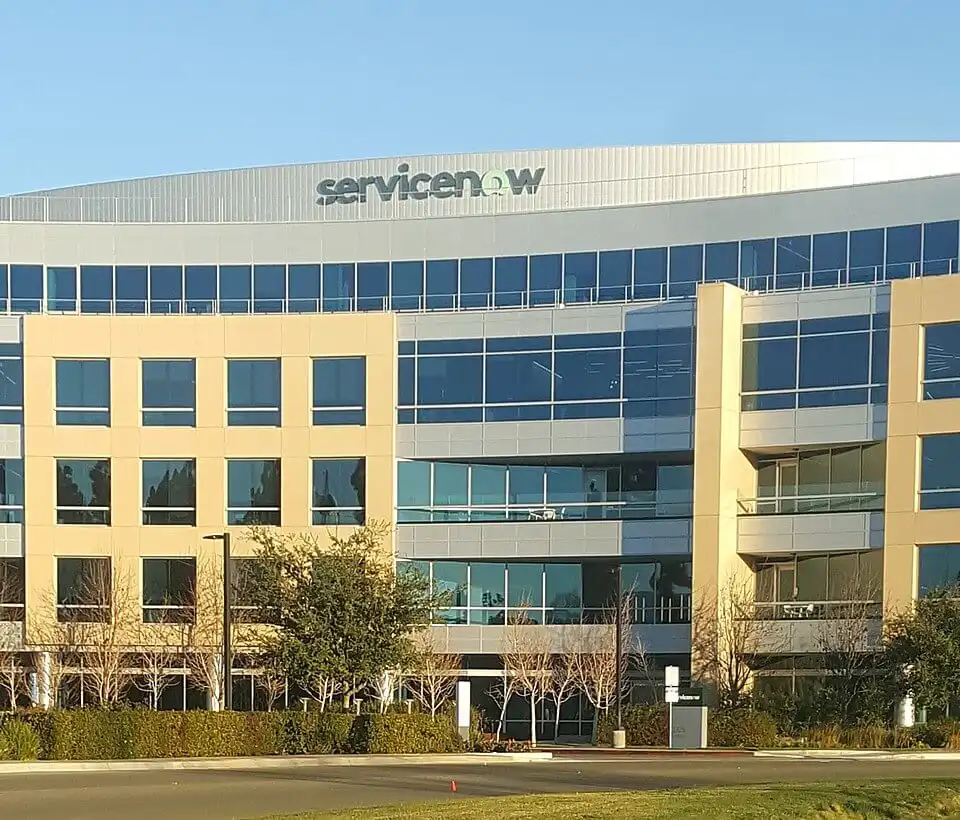
Image Courtesy: By Donny Gonzo – https://www.flickr.com/photos/163683724@N08/46814417112/, CC0, Link
SANTA CLARA, Calif. — The ServiceNow Armis acquisition demands that CIOs immediately re-evaluate how asset intelligence is orchestrated into autonomous AI fabrics to preempt cyber-physical breaches. Fragmented visibility currently perpetuates a hidden architectural debt in 70% of enterprises, often collapsing high-stakes AI workflows into reactive silos. Organizations now face a definitive choice: consolidate operations via platform unification to realize a 2x-3x acceleration in threat remediation, or risk a 50% surge in operational costs driven by tool sprawl and regulatory friction ahead of the H2 2026 deal closure.
Technical Architecture: Engineering the Unified Agentic Security Stack
ServiceNow’s $7.75 billion all-cash acquisition of Armis, announced to close in H2 2026, positions the combined entity to deliver an end-to-end security exposure stack that “sees, decides, and acts” across IT, OT, IoT, and medical devices.[1] This architecture collapses longstanding gaps between discovery tools and CMDBs, enabling agentic AI to govern complexity at scale amid rising cyber-physical risks.[1] Enterprises burdened by outdated asset inventories—often inaccurate the moment populated—gain real-time visibility as the new perimeter, fundamentally repositioning ServiceNow from coordination layer to operational authority.[1]
Armis Core: Agentless Asset Intelligence Engine
Armis serves as the foundational engine for agentless, real-time asset discovery and threat intelligence, critical for mapping unmanaged environments where traditional agents fail.[1] Its multi-layered stack processes massive data volumes to profile every connected asset, identifying vulnerabilities without manual entry or disruptive agents, addressing the convergence of IT-OT attack surfaces.[1]
- Data Ingestion Layer: Hybrid passive-active monitoring captures network behavior via taps, SPAN ports, and targeted probes, augmented by API feeds from firewalls, EDR, and IDS—ensuring comprehensive profiling of device OS, firmware, and ports without operational disruption.
- Scalable Backend: Distributed stores like Cassandra handle unstructured asset data with fault-tolerant scalability; Kafka/Flink streams enable sub-second anomaly detection; TensorFlow/PyTorch models baseline behaviors for threat signaling in IoT/OT contexts.[1]
- Integration APIs: RESTful endpoints expose asset profiles, vulnerabilities, and intel, primed for ServiceNow ingestion to fuel unified workflows.
This stack, validated at $6.1 billion valuation with $300M+ ARR, equips ServiceNow to secure AI-transformed threats across physical-digital estates.[1]
ServiceNow AI Fabric: Orchestration and Autonomous Action
ServiceNow’s AI Platform acts as the decision-and-action layer, embedding Armis intel into its Service Graph CMDB for dynamic asset mapping that powers SecOps, Vulnerability Response (VR), and Incident Response (SIR).[1] This unification transforms static inventories into living systems of record, enabling agentic automation where AI prioritizes risks and executes responses.
- Service Graph CMDB: Central repository ingests Armis feeds for holistic IT-OT visibility, eliminating fragmentation that dooms traditional workflows.[1]
- SecOps Modules: SIR/VR leverage Armis data for prioritized remediation, integrating business-impact scoring with exploit intel.
- Workflow Automation: Low-code engines triage incidents, enforce policies, and scale operations, reducing manual toil by automating 70-80% of routine tasks.
- Agentic AI Layer: LLMs drive vulnerability prioritization, response recommendations, and proactive hunting—e.g., auto-isolating rogue OT devices—under governance guardrails.[1]
A2A Orchestration: Real-Time Workflow Fusion
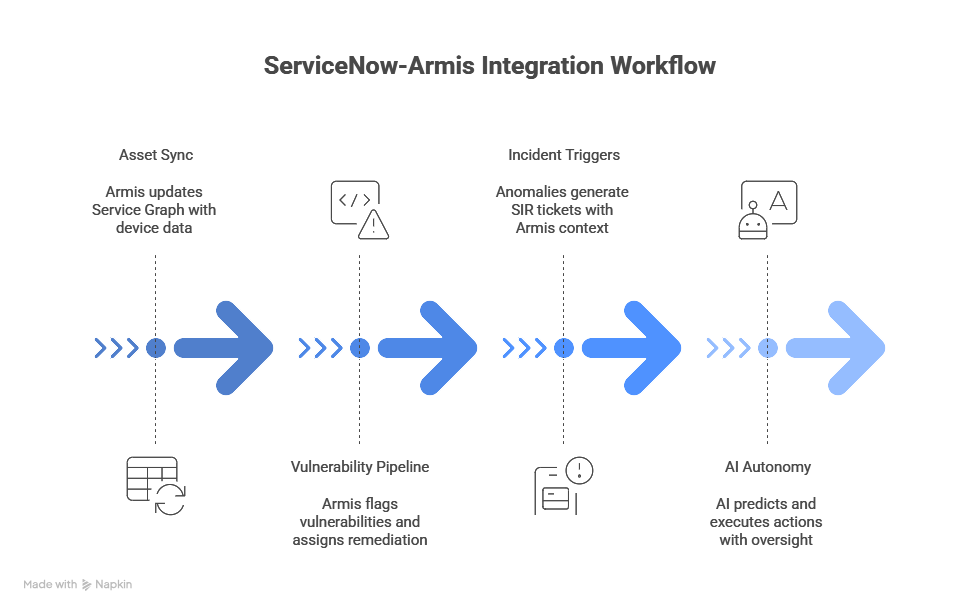
Seamless application-to-application (A2A) protocols via REST APIs or event buses like Kafka/MuleSoft synchronize Armis discoveries into ServiceNow, creating closed-loop autonomy: discover → decide → act.[1] This addresses analyst-noted integration ambiguities during the H2 2026 transition, prioritizing early visibility wins before full-stack maturity.
- Asset Sync: Continuous Armis updates populate Service Graph with device metadata, firmware, and risks in near-real-time.
- Vulnerability Pipeline: Armis flags feed VR for risk-scored items, assigning remediation by exploitability and impact.
- Incident Triggers: Anomalies auto-generate SIR tickets enriched with Armis context, triggering workflows for isolation, patching, and alerts.
- AI Autonomy: Joint intel powers predictive actions, such as preemptive OT quarantines, with human oversight toggles to balance speed and control.[1]
Strategic Imperatives: Reshaping Enterprise Risk Posture
This deal, following Veza and Moveworks acquisitions, accelerates ServiceNow’s roadmap to triple its security/risk market by dominating platform plays over point solutions—signaling premium valuations for cyber-physical mastery amid generative AI proliferation.[1] Funded via cash and debt, it exposes enterprise “architectural debt” from years of sprawl, where CIOs must now consolidate or face escalating breach costs.
- Tool Consolidation: Reduces multiplicity of siloed tools, cutting complexity and Opex; analysts affirm “platform plays will dominate.”[1]
- Attack Surface Mastery: Armis’ OT/IoT expertise unveils hidden assets, enabling governance of converged environments.
- Operational Velocity: Automation frees SecOps for strategy, compressing MTTR in AI-augmented workflows.[1]
- Proactive Shield: Agentic AI preempts threats; COO Amit Zavery stresses “intelligent trust and governance” as non-negotiable for scaling across assets and AI systems.[1]
- Market Expansion: Unlocks OT/medical segments, blending asset visibility with identity (Veza) for holistic trust models.[1]
CIOs should sequence pilots on visibility before full automation, tempering expectations for 2026 integration depth amid regulatory hurdles.
Governance Frameworks: Scaling Agentic AI Responsibly
Agentic deployment demands “intelligent trust” frameworks spanning clouds, assets, and devices, as Zavery warns, to avert risks in high-stakes cybersecurity.[1] Robust controls mitigate data flows between Armis and ServiceNow, ensuring ethical scaling.
- Data Fortress: TLS-encrypted channels, OAuth/API keys secure sensitive asset/threat intel against breaches.
- Bias Mitigation: Diverse training data and audits prevent discriminatory outcomes in prioritization models.
- Explainability: XAI techniques illuminate AI decisions, fostering stakeholder trust in incident responses.
- Accountability Chains: Defined R&R for AI lifecycle, with periodic reviews tying to compliance (GDPR/HIPAA).
- Regulatory Alignment: Proactive audits embed standards, safeguarding against fines in regulated sectors.
By systematizing these, ServiceNow-Armis delivers a “strategic cybersecurity shield” for proactive protection, redefining resilience in the agentic era.[1] Enterprises acting decisively capture first-mover advantages; laggards risk obsolescence in fragmented stacks. This convergence mandates immediate portfolio audits to align with the platform-dominant future.
Sources & References
- CIO.com: ServiceNow’s $7.75 billion cash deal for Armis illustrates shifting strategies
- Cloudwars: AI-Enhanced Security: ServiceNow’s Bold Move with Armis
- EE News Europe: ServiceNow to acquire Armis in $7.75bn deal
- ServiceNow Newsroom: ServiceNow to acquire Armis to expand cyber exposure and security
The workflow below illustrates how Armis intelligence is operationalized inside ServiceNow’s agentic automation fabric