
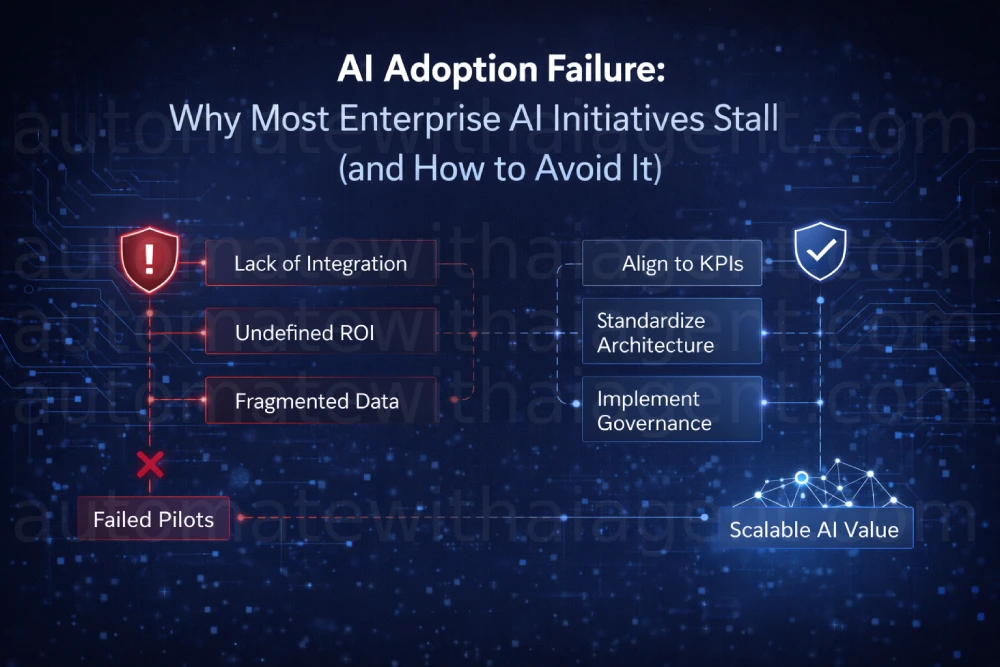
Image: AI Created
AI adoption failure is rarely caused by poor models or weak algorithms. It happens when organizations attempt to layer artificial intelligence onto legacy workflows without redesigning operations around measurable business outcomes.
Why Most AI Adoption Fails (And How to Avoid It) is not a question of model performance or vendor choice. It is a question of execution.
Despite growing enterprise investment in artificial intelligence, industry research shows that many AI initiatives stall between pilot and full-scale deployment. Harvard Business Review notes that organizations frequently struggle to translate experimentation into measurable operational value. [1]
The core issue is rarely the technology itself. It is the absence of workflow integration, governance clarity, and ROI accountability from the start.
- AI fails when treated as an isolated tool instead of a workflow redesign initiative.
- Pilots stall when ROI metrics are undefined before deployment.
- Scaling succeeds only when architecture, governance, and change management move together.
Our view: Most AI adoption fails because enterprises attempt to layer AI onto legacy processes rather than reengineering operations around measurable business outcomes.
Enterprise AI implementation should begin with business objectives, not model experimentation. McKinsey’s State of AI research consistently shows that organizations capturing significant value from AI redesign workflows, align leadership accountability, and prioritize data readiness. [2]
This means defining outcome KPIs (cycle time reduction, cost efficiency, revenue acceleration) before selecting tools. AI adoption is an operational strategy decision, not just a technology deployment.
Deloitte reports that integration complexity and unclear ownership are among the most common barriers to enterprise AI scaling. [3]
PwC similarly emphasizes that value realization depends heavily on governance, trust frameworks, and workforce alignment rather than algorithm sophistication alone. [4]
Organizations that embed AI into core workflows — rather than treating it as experimentation — demonstrate stronger performance improvements and faster scaling.
Why AI Adoption Fails in Enterprises
Most AI adoption failures stem from structural misalignment. Enterprises often launch pilots within isolated departments without integrating them into end-to-end workflows. The result is localized efficiency without systemic impact.
When executive ownership is unclear and business KPIs are undefined, projects drift. Technology teams focus on model accuracy while business leaders wait for financial results that were never operationalized.
The Real Causes Behind Failed AI Initiatives
Common failure patterns include:
- Lack of defined ROI before deployment
- Poor data quality and fragmented data pipelines
- Limited cross-functional alignment
- No governance model for oversight and risk management
- Insufficient workforce enablement and change management
Harvard Business Review highlights that organizations frequently underestimate the process redesign required for AI to deliver measurable business value. [1]
How to Avoid AI Adoption Failure: A Practical Framework
Avoiding failure requires disciplined execution across five dimensions:
1. Define Business Outcomes First
Start with measurable KPIs. AI initiatives should map directly to performance metrics such as revenue growth, operational efficiency, error reduction, or customer satisfaction improvement.
2. Establish a Modular Integration Layer
AI services should integrate via APIs into existing enterprise systems. A modular architecture prevents disruption and enables controlled scaling.
3. Embed AI into Workflows, Not Dashboards
AI should trigger decisions within operational systems, not exist as standalone analytics outputs. Workflow-native integration drives adoption and measurable impact.
4. Implement Governance from Day One
Risk management, model monitoring, and human oversight must be designed early. PwC emphasizes trust and governance as prerequisites for sustained AI value. [4]
5. Prioritize Change Management
AI transformation requires workforce enablement. Training and communication reduce resistance and accelerate adoption.
From Pilot to Production: The Scaling Shift
Successful enterprises move from experimentation to embedded operational capability by:
- Creating cross-functional AI leadership councils
- Tracking ROI continuously
- Standardizing data pipelines
- Expanding successful use cases incrementally
McKinsey research indicates that companies redesigning processes around AI, rather than layering AI onto existing workflows, capture significantly more value. [2]
AI adoption does not fail because the models are inadequate. It fails when organizations underestimate the structural redesign required for enterprise-scale value creation.
Industry research consistently highlights that organizations focusing on governance, data readiness, and workflow redesign achieve stronger AI performance outcomes than those focused purely on experimentation. [2]
Structured adoption frameworks reduce pilot stagnation and accelerate measurable business impact.
Immediate Actions (Next 90 Days): Identify one high-impact workflow. Define clear KPIs. Integrate AI via APIs into operational systems. Establish monitoring dashboards and governance oversight. Measure results weekly.
Medium-Term Strategy: Expand AI integration across adjacent workflows. Formalize governance structures. Standardize data infrastructure.
Long-Term Scaling: Redesign core business processes around AI capabilities rather than retrofitting tools into legacy systems.
Sources & References
- Harvard Business Review: Why AI Adoption Stalls
- McKinsey & Company: The State of AI 2023
- Deloitte Insights: State of AI and Intelligent Automation
- PwC Global AI Study: Sizing the Prize
This analysis draws on publicly available research as of February 2026. Enterprise AI strategy decisions warrant independent technical and governance validation.
Prepared by the Automatewithaiagent Team
Strategic Implementation & AI Architecture Division