
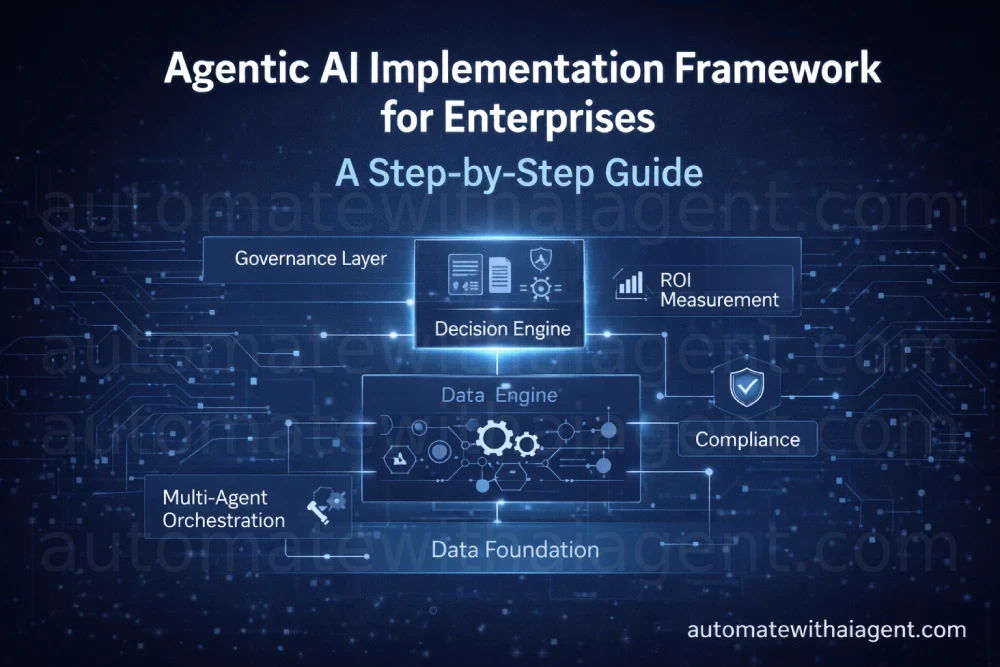
Image: AI Created
Agentic AI implementation framework design is no longer optional for enterprises seeking scalable, governed, and ROI-driven AI deployment. Enterprise adoption of Agentic AI is accelerating—but most organizations still approach it incorrectly. According to McKinsey’s 2023 Global AI Survey, 55% of organizations report adopting AI in at least one function, yet only a small percentage capture significant financial impact at scale. [1] The gap is not technological—it is structural. Enterprises that treat AI agents as experimental tools see incremental efficiency gains. Organizations that adopt a structured implementation framework—governance-first, integration-ready, ROI-measured—unlock compounding value across departments. This guide outlines a practical, step-by-step framework for adopting Agentic AI safely, strategically, and at enterprise scale.
Our view: Agentic AI adoption is not an AI project—it is an operating model transformation. Enterprises that follow a structured adoption roadmap consistently reduce implementation risk, accelerate time-to-value, and position themselves for multi-agent scale. Those that deploy agents without architecture, governance, and measurable ROI discipline typically stall at pilot stage.
- Strategy before software: AI agents must be tied to measurable business outcomes—not experimentation.
- Data readiness determines performance: Agent effectiveness depends on structured, accessible, and governed enterprise data.
- Governance enables scale: Deloitte research shows organizations with strong AI governance frameworks are significantly more likely to achieve expected value from AI initiatives. [2]
- Multi-agent orchestration is the long-term advantage: Enterprises that integrate AI across multiple workflows see broader operational impact than isolated deployments.
The strategic question is not whether to adopt Agentic AI. The real question is: How do we implement it without creating fragmentation, compliance risk, or wasted investment? Below is a seven-step enterprise-ready implementation framework grounded in industry research, operational best practices, and observed enterprise adoption patterns.
Step 1: Executive Alignment and Clear Business Objectives
Successful Agentic AI adoption begins at the executive level. McKinsey reports that companies achieving the highest AI impact align initiatives directly with core business priorities rather than IT experimentation. [1]
Define:
- Primary objective (cost reduction, revenue growth, risk mitigation)
- Target business function
- Measurable KPIs
- Budget and governance ownership
Without executive alignment, AI agents remain siloed tools instead of enterprise capabilities.
Step 2: Enterprise Process Audit and Use Case Prioritization
Not every process should be automated with AI agents. Prioritize high-volume, repetitive, decision-heavy workflows where measurable impact is clear.
Use a simple prioritization formula:
Impact Score = (Volume × Time Saved × Error Reduction Potential × Strategic Value)
Gartner emphasizes that organizations must focus AI efforts on well-defined, high-impact use cases to move beyond pilots. [3]
Step 3: Data Readiness and Infrastructure Assessment
Agentic AI performance depends on data quality. Before deployment, assess:
- Structured data availability
- API accessibility across systems
- Data governance policies
- Security and compliance controls
BCG research indicates that data maturity strongly correlates with AI success rates. Organizations with advanced data governance significantly outperform peers in AI value capture. [4]
Step 4: Pilot Agent Deployment (Controlled Environment)
Deploy one high-impact agent in a controlled business function. Avoid broad rollouts initially.
Measure:
- Cycle time improvement
- Error rate reduction
- Employee productivity gains
- Customer impact metrics
The objective is measurable validation—not scale.
Step 5: Governance Framework Implementation
Before scaling, implement:
- Role-based access controls
- Human-in-the-loop escalation thresholds
- Audit logging of agent decisions
- Performance monitoring dashboards
- Compliance oversight processes
Deloitte’s AI governance research highlights that formal oversight structures reduce operational and regulatory risk significantly. [2]
Step 6: Multi-Agent Integration Architecture
After pilot validation, design integration architecture that enables:
- Cross-departmental workflow handoffs
- Shared data learning loops
- API orchestration across systems
- Central monitoring and performance tracking
This is where linear automation becomes scalable Agentic AI.
Step 7: Continuous ROI Measurement and Optimization
AI agent value compounds when measured consistently.
Track:
- Hard ROI (cost savings, revenue acceleration)
- Soft ROI (decision quality, compliance reduction, customer experience)
- Adoption rates across teams
- Expansion opportunities
Organizations that revisit ROI quarterly are more likely to scale successfully, according to industry AI adoption studies. [1]
Observed enterprise adoption benchmarks from public research:
- AI Adoption Rate: 55% of organizations report AI use in at least one function. [1]
- Top Performers: Companies with strong governance and data maturity outperform peers in value realization. [4]
- Pilot-to-Scale Challenge: Many organizations struggle to move beyond experimentation without structured frameworks. [3]
Immediate Actions (Next 90 Days): Conduct executive alignment sessions, identify one high-impact workflow, perform a data readiness audit, and design governance protocols before deployment.
Medium-Term (Months 4–12): Deploy pilot agent, measure impact, build integration architecture, formalize monitoring dashboards.
Long-Term (Year 2+): Expand to multi-agent orchestration across departments, redesign workflows around autonomous capabilities, institutionalize quarterly ROI reviews.
Strategic Imperative: Agentic AI adoption is most successful when approached as structured transformation—not experimentation.
Ready to Operationalize Agentic AI at Scale?
Most enterprises do not fail at AI because of technology limitations — they fail due to unclear governance, weak integration architecture, and undefined ROI measurement.
If you are evaluating Agentic AI implementation across business units and need architectural clarity, governance structuring, or ROI modeling support, our team works with enterprise leaders to design scalable AI operating models.
We specialize in:
- Enterprise Agentic AI implementation roadmaps
- Multi-agent architecture and orchestration design
- AI governance frameworks and compliance alignment
- ROI modeling and value realization planning
For confidential advisory conversations, reach out at
contact@automatewithaiagent.com
or use the enterprise inquiry form on our website.
Sources & References
- McKinsey & Company – The State of AI in 2023 [1]
- Deloitte – State of AI in the Enterprise [2]
- Gartner – AI Hype Cycle Insights [3]
- Boston Consulting Group – Winning with AI [4]
Disclaimer: This analysis draws on publicly available reporting as of February 2026. Enterprise AI strategy decisions warrant independent technical and governance validation.
Prepared by the Automatewithagent Team
Strategic Implementation & AI Architecture Division