
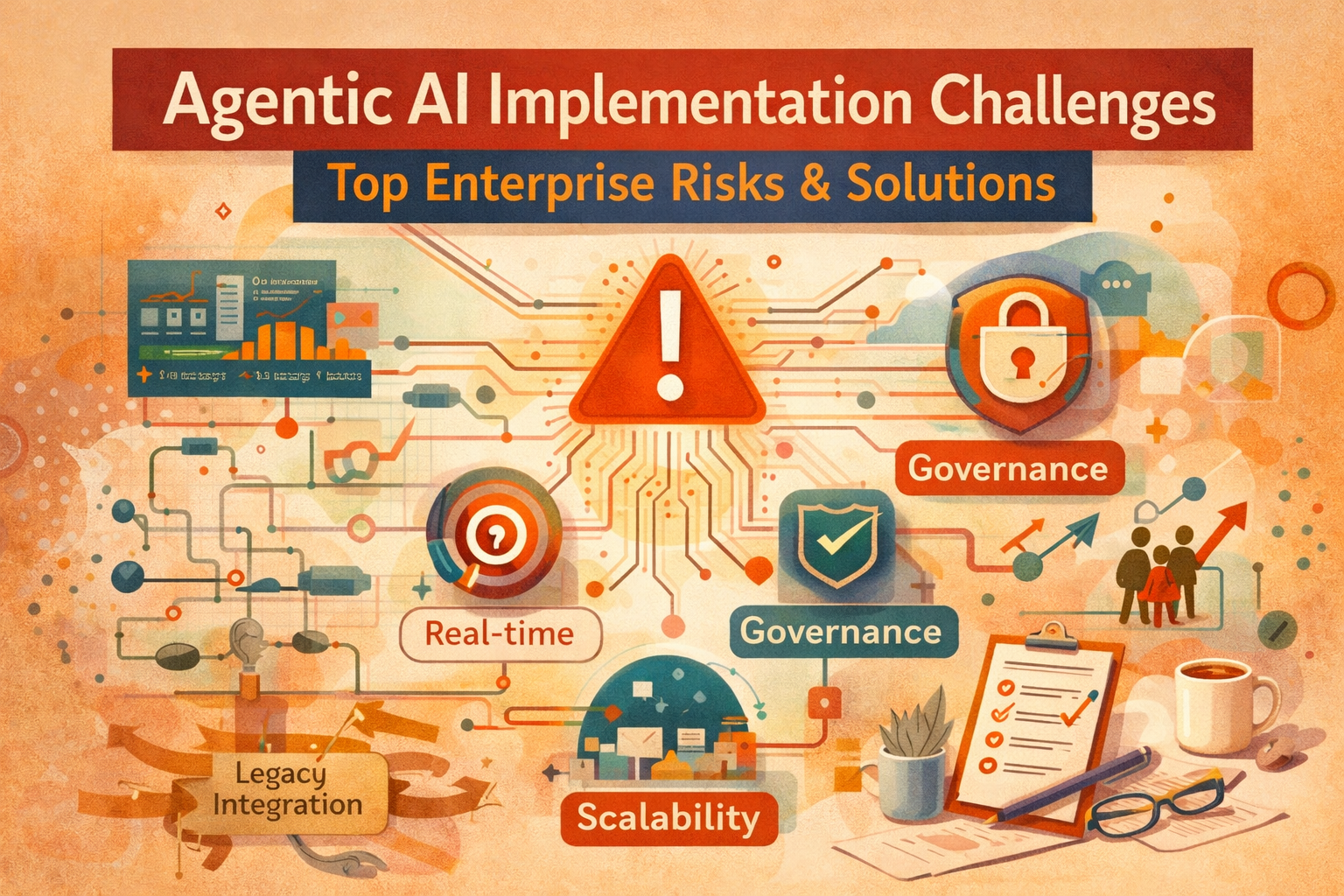
Definition (Featured Snippet Ready): Agentic AI implementation challenges refer to the structural, technical, and operational barriers that prevent organizations from successfully deploying and scaling autonomous AI systems across enterprise workflows.
Key Insight: The failure of Agentic AI initiatives is rarely due to model capability. It is primarily driven by weak architecture, poor data readiness, and lack of governance frameworks.
Top Challenges in Agentic AI Implementation
1. Lack of Clear Business Alignment
Many organizations deploy AI agents without defining measurable business outcomes. This results in fragmented use cases and unclear ROI.
Solution: Align every Agentic AI initiative with specific KPIs such as cost reduction, revenue growth, or risk mitigation.
2. Data Fragmentation and Poor Data Quality
Agentic systems depend heavily on structured and reliable data. Disconnected data sources lead to inaccurate outputs and unreliable decisions.
Solution: Establish centralized data pipelines, governance policies, and real-time data access frameworks.
3. Weak Governance and Control Mechanisms
Without proper governance, AI agents can operate without sufficient oversight, increasing operational and compliance risks.
Risk: Uncontrolled AI execution can lead to incorrect decisions, security vulnerabilities, and regulatory issues.
Solution: Implement role-based access, audit logs, human-in-the-loop checkpoints, and policy-driven execution controls.
4. Integration Complexity with Legacy Systems
Most enterprises operate on legacy infrastructure that is not designed for real-time AI-driven workflows.
Solution: Use API-based integration layers and phased modernization strategies to enable compatibility.
5. Lack of Scalable Multi-Agent Architecture
Single-agent systems are insufficient for complex enterprise workflows, leading to scalability bottlenecks.
Insight: Enterprises must move toward multi-agent orchestration models similar to microservices architecture.
Solution: Design hierarchical agent systems with orchestration and supervision layers.
6. Unclear ROI Measurement
Organizations often fail to define and track ROI metrics, making it difficult to justify scaling investments.
Solution: Track both hard ROI (cost savings) and soft ROI (efficiency, accuracy, customer experience).
7. Security and Access Control Risks
AI agents interacting with multiple systems increase the attack surface and risk of unauthorized access.
Risk: Improperly secured agents can expose sensitive enterprise data.
Solution: Enforce strict authentication, access controls, and continuous monitoring.
8. Organizational Resistance and Change Management
Employees may resist AI adoption due to fear of job displacement or lack of understanding.
Solution: Invest in training, communication, and change management programs.
Challenge Impact vs Solution Priority
| Challenge | Impact Level | Priority |
|---|---|---|
| Data Quality | High | Critical |
| Governance | High | Critical |
| Integration | Medium | High |
| ROI Measurement | Medium | High |
Enterprise Implementation Perspective
Organizations that successfully deploy Agentic AI treat it as a system-level transformation rather than a standalone technology initiative.
For implementation guidance:
Agentic AI Implementation Framework for Enterprises
Reality Check: Most failures occur during scaling—not during initial deployment. The difference lies in architecture and governance maturity.
FAQs
1. Why do most Agentic AI projects fail?
Due to lack of governance, poor data quality, and unclear ROI.
2. What is the biggest challenge?
Data readiness and governance frameworks.
3. Can these challenges be avoided?
Yes, with structured implementation and phased deployment.
4. Do enterprises need multi-agent systems?
Yes, for scalability and complex workflows.
5. How should companies start?
With high-impact use cases and controlled pilots.
6. Is Agentic AI risky?
It introduces risks if not properly governed.
Ready to Navigate Agentic AI Implementation Challenges?
Most organizations underestimate the complexity of deploying Agentic AI at scale. The difference between success and failure lies in how these challenges are addressed early in the process.
We help enterprises with:
- Agentic AI implementation strategy
- Governance and compliance frameworks
- Multi-agent architecture design
- ROI measurement and scaling roadmap
Contact:
contact@automatewithaiagent.com
Sources
- McKinsey & Company – State of AI
- Deloitte – AI in Enterprise
- Gartner – AI Trends
- https://www.mckinsey.com/
- https://www2.deloitte.com/
Disclaimer: This analysis draws on publicly available reporting as of March 2026. Enterprise AI strategy decisions warrant independent validation.
Prepared by the Automatewithaiagent Team
Strategic Implementation & AI Architecture Division