
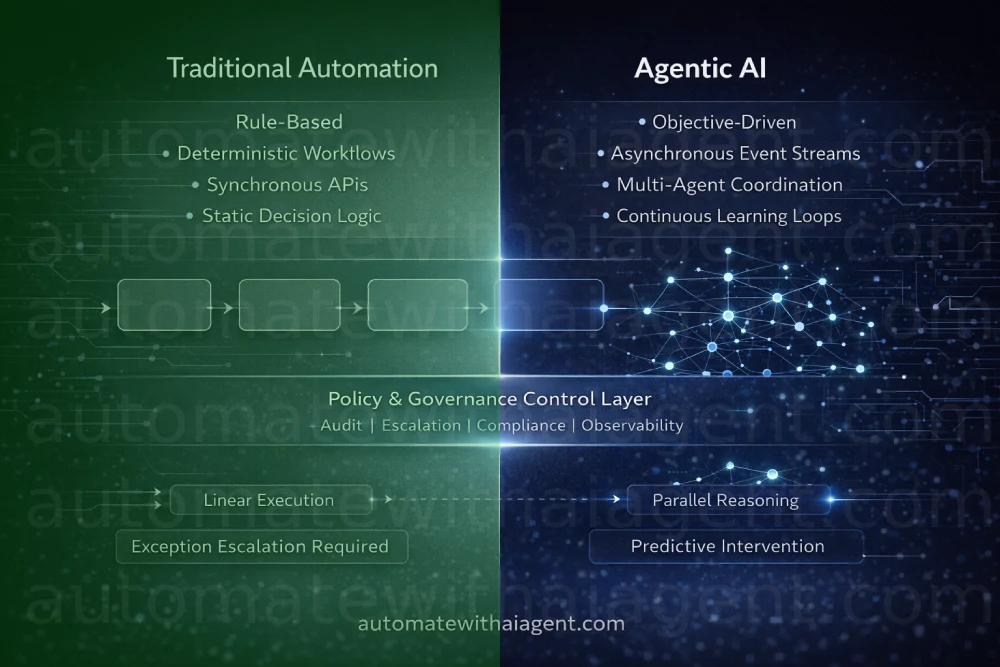
Agentic AI vs Traditional Automation is not a battle between old and new technologies. It is a question of control versus adaptability. Traditional automation excels at predictable, rule-based processes. Agentic AI systems are designed to reason, adapt, and act across dynamic conditions.
According to Harvard Business Review, many organizations struggle to move AI initiatives from experimentation to operational value because systems are layered onto existing workflows without redesigning how decisions are made. [1] The distinction between automation and agentic systems becomes critical when enterprises aim to scale beyond isolated pilots.
- Our view: Agentic AI is not a replacement for traditional automation. It is an architectural extension designed to manage exceptions, optimize across systems, and support proactive decision-making.
- Traditional automation remains essential for deterministic, high-volume workflows such as invoice processing and order entry.
- Agentic systems create value when embedded within governance guardrails and integrated into enterprise decision flows.
Enterprises should not frame the decision as “AI versus automation.” The strategic question is how to design a hybrid architecture where deterministic processes remain stable, while adaptive systems handle complexity, volatility, and cross-functional coordination. The integration layer becomes the governance checkpoint that ensures agent decisions align with policy, compliance, and risk thresholds.
Industry research consistently shows that workflow redesign, governance clarity, and integration discipline are stronger predictors of AI success than model sophistication alone. [2] Organizations that embed AI within core business processes are more likely to report measurable impact than those that deploy tools in isolation.
What Traditional Automation Does Well
Traditional automation, including RPA and workflow engines, operates on predefined logic. If condition X occurs, execute action Y. These systems are reliable, auditable, and efficient for repetitive processes.
For example:
- Processing invoices based on structured data fields
- Routing customer tickets based on category rules
- Generating compliance reports from known datasets
These systems are deterministic. Outcomes are known in advance. This predictability makes them highly governable and scalable for stable operations.
Where Traditional Automation Breaks
Traditional systems struggle when conditions deviate from predefined logic. Supply disruptions, unexpected demand spikes, or incomplete data inputs require human intervention.
This leads to operational bottlenecks. Manual exception handling slows resolution times and introduces inconsistency. According to McKinsey’s State of AI research, organizations frequently cite integration challenges and workflow misalignment as major barriers to AI scaling. [2]
How Agentic AI Is Different
Agentic AI systems operate through continuous reasoning loops. Rather than executing fixed rules, agents evaluate context, weigh options, and select actions aligned with defined objectives.
Instead of encoding “if-then” logic, organizations encode goals:
- Minimize supply chain disruption
- Reduce resolution time
- Optimize throughput
The agent determines how to reach the objective based on current conditions.
Architectural Differences
Traditional automation architectures are typically synchronous and rule-based. Agentic architectures are often event-driven and distributed. Agents communicate through asynchronous messaging systems, enabling parallel coordination across functions.
However, distributed reasoning introduces governance complexity. When multiple agents act on shared data, organizations must ensure consistency, traceability, and auditability.
The Integration Layer as Control Mechanism
A mature hybrid model introduces a policy enforcement layer between agents and operational systems. Agents recommend actions. The integration layer validates them against:
- Compliance rules
- Capacity constraints
- Risk thresholds
Only validated actions are executed. This preserves adaptability without sacrificing control.
Domain Specialization Over General Intelligence
Enterprises often fail by attempting to deploy broad, general-purpose agents. More reliable results emerge when agents are domain-specialized.
For example:
- A procurement agent trained on supplier data
- A production agent trained on scheduling logic
- A logistics agent trained on routing constraints
Domain grounding improves decision accuracy and simplifies governance.
Predictive Versus Reactive Systems
Traditional automation responds to events. Agentic systems can anticipate them. Research from Deloitte highlights the growing role of predictive analytics in operational decision-making. [3]
Predictive intervention allows enterprises to act before disruptions fully materialize, improving resilience.
Risks of Poorly Governed Agentic Systems
Without strong governance:
- Agents may operate outside defined authority
- Model drift may degrade performance over time
- Decision traceability may weaken
Establishing clear boundaries, monitoring systems, and escalation pathways is essential before scaling autonomy.
What Enterprises Need to Know
Agentic AI vs Traditional Automation is not an either-or decision. The strongest architectures:
- Retain deterministic automation for stable workflows
- Introduce agentic reasoning for exceptions and optimization
- Enforce governance through integration checkpoints
- Continuously monitor model performance and drift
This hybrid approach balances adaptability with control.
Enterprise leaders evaluating Agentic AI vs Traditional Automation should begin with an architecture assessment, not a vendor selection. If you’re exploring how to design a governed hybrid automation strategy, our team works with organizations to define integration models, agent boundaries, and ROI measurement frameworks aligned to operational realities.
Sources & References
- Harvard Business Review: Why AI Adoption Stalls
- McKinsey & Company: The State of AI
- Deloitte Insights: AI Strategy Research
This analysis draws on publicly available research and industry reporting as of February 2026. Enterprise AI strategy decisions warrant independent technical and governance validation.
Prepared by the Automatewithaiagent Team
Strategic Implementation & AI Architecture Division
