
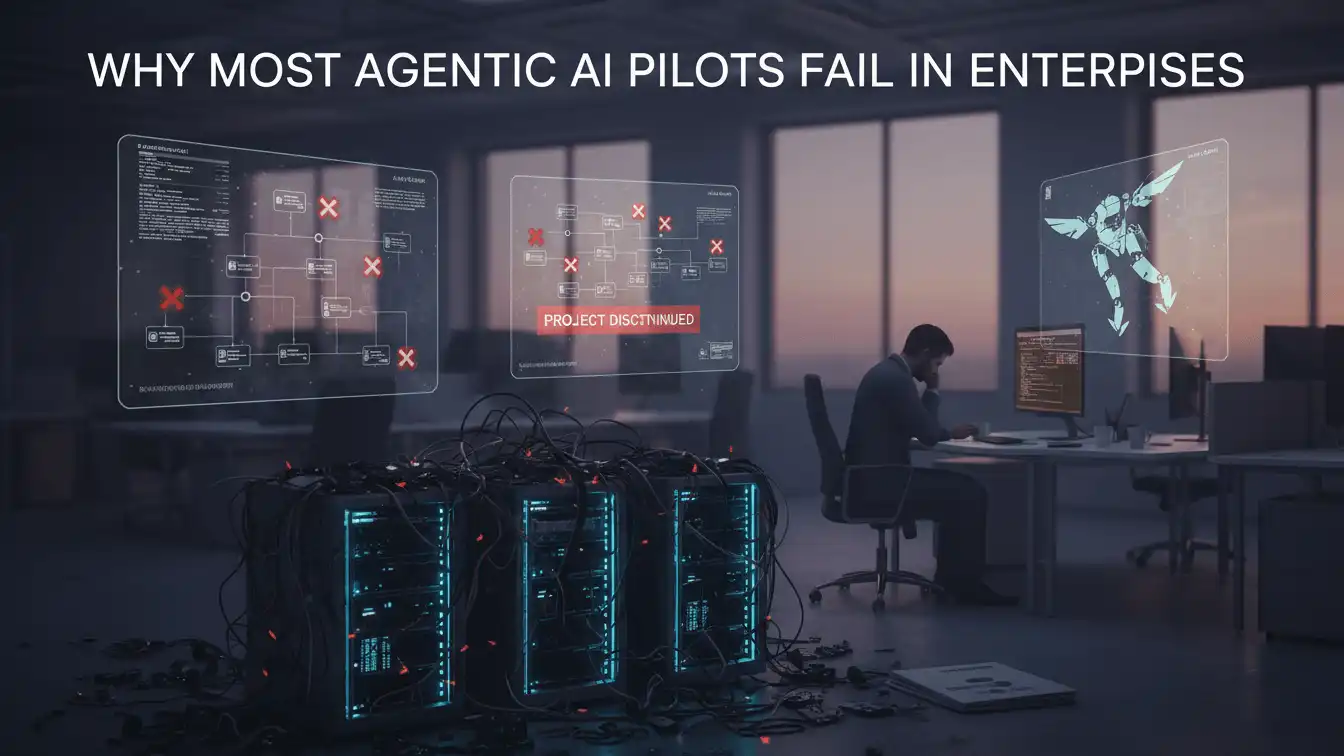
Why most agentic AI pilots fail in enterprises has little to do with model capability and everything to do with architecture and operating discipline. While agentic AI promises autonomy and efficiency, most pilots collapse when deployed without governance, escalation logic, and integration into real enterprise workflows. Organizations that succeed treat agentic AI as operational infrastructure, not experimental software.
Agentic AI initiatives fail because enterprises deploy autonomy without discipline. Autonomous systems behave less like software and more like new organizational actors. Treating them as traditional IT projects—build, deploy, monitor—creates systemic fragility rather than scalable value.Our experience shows three principles consistently separate failed pilots from successful deployments:
- Autonomy requires architecture, not just models. Generic LLMs lack workflow context, domain boundaries, and feedback loops required for enterprise use.
- Governance enables scale. Audit trails, role-based access, and escalation thresholds are not compliance overhead; they are the foundation of safe autonomy.
- Pilots must be learning systems. The goal is not flawless demos but early exposure of failure modes that harden architecture before scale.
The Enterprise Paradox: Why Agentic AI Pilots Look Successful but Fail in Production
Most enterprises experimenting with agentic AI experience early success in controlled pilots. Data is curated, workflows are simplified, and edge cases are minimal. The illusion of readiness quickly collapses once these systems encounter live operations—messy data, system outages, human variability, and regulatory constraints.
This is why agentic AI pilots fail in enterprises even when the underlying models perform well. Generic AI tools do not learn from organizational outcomes, adapt to internal processes, or integrate deeply into systems of record. They are deployed as assistants, not embedded as operational actors.
The Five Structural Reasons Agentic AI Pilots Fail
1. Treating Agentic AI Like Traditional Automation
Many organizations approach agentic AI the same way they approached RPA—map the process, deploy the agent, and expect stability. Autonomous systems require continuous boundary refinement, training, and supervision. Without this, edge cases force human intervention, eroding trust and ROI.
2. Vague or Non-Operational Success Metrics
Pilots often launch with goals such as “increase productivity” or “improve efficiency.” Without precise, measurable outcomes—cycle time reduction, accuracy thresholds, escalation frequency—teams cannot distinguish real value from experimental noise.
3. Ignoring the Human Operating Context
Agents designed without end-user involvement rarely align with how work actually happens. Employees bypass systems that disrupt workflows or obscure accountability. Successful deployments treat agents as collaborators, not replacements.
4. Proof-of-Concept Architecture in Production
Pilots that lack resilience, error handling, and fallback paths fail immediately in real environments. Production-grade autonomy assumes failure will occur and designs escalation mechanisms accordingly.
5. Automating Entire Workflows Too Early
Attempting end-to-end automation across multiple systems introduces too many dependencies at once. Organizations that succeed automate narrowly, stabilize performance, and expand scope incrementally.
The Architecture of Bounded Autonomy
Enterprises that move beyond pilot failure design for bounded autonomy. Agents operate independently within defined authority zones. Every action is logged, auditable, and subject to approval thresholds. Ambiguity triggers escalation, not improvisation.
This approach reframes autonomy from a risk into a controllable asset. Governance is embedded into execution rather than layered on afterward.
STRATEGIC TAKEAWAYS FOR ENTERPRISE LEADERS:
- Audit your AI portfolio for the learning gap. Identify where tools operate in isolation versus learning from operational outcomes.
- Establish governance before scaling pilots. Escalation logic, auditability, and role ownership must precede autonomy.
- Start with internal, lower-risk workflows. Back-office operations provide faster learning with less reputational exposure.
- Empower domain owners. Those closest to the work understand constraints better than centralized AI teams.
- Design for failure from inception. Production-grade autonomy assumes errors and plans for them.
Agentic AI pilots fail not because the technology is immature, but because enterprises deploy autonomy without an operating model to sustain it. Autonomy is not a feature—it is a responsibility. Organizations that architect for governance, learning, and escalation move beyond pilots into durable operational value.
Disclaimer: This analysis pertains to technological strategy and does not constitute financial, legal, or security advice. Consult domain specialists for market-impacting decisions.
Prepared by the Automatewithaiagent Team
Strategic Implementation & AI Architecture Division